GTO poker stands for Game Theory Optimal poker — a way of playing built on the mathematics of game theory rather than on reading any single opponent. Over the past decade it has become the dominant framework in high-stakes play, and the term now appears constantly in training videos, forums and TV commentary. This guide explains what GTO actually means, how it differs from the older “exploitative” style, the key numbers behind it (balance, minimum defense frequency and bluff ratios), and how the software “solvers” that popularized it really work — all in plain English, with no advanced maths required.
Key Points
- GTO means Game Theory Optimal. It is a balanced strategy based on the Nash equilibrium that no opponent can beat over the long run — its exploitability is zero.
- It is a defensive floor, not a jackpot. Perfect GTO guarantees at worst break-even in a heads-up game; it is not always the highest-earning approach.
- Exploitative play is the alternative. It deviates from GTO to punish an opponent’s specific leaks — often more profitable against weak players, but open to being countered.
- The key numbers are balanced ranges, mixed strategies, minimum defense frequency (MDF) and value-to-bluff ratios.
- Solvers such as PioSolver and GTO Wizard approximate equilibrium using counterfactual regret minimization (CFR).
- Best used as a baseline, then adjusted exploitatively when you have reliable reads.
What is GTO poker?
GTO poker is a strategy based on the Nash equilibrium: a set of plays so perfectly balanced that no opponent can change their own approach to beat you over the long run. If you play a true GTO strategy, your opponent can know exactly what you are doing and still be unable to profit from it. In the language of game theory, your strategy has zero “exploitability.”
The idea comes from two-player, zero-sum games — situations where one player’s gain is exactly the other’s loss, like heads-up (one-on-one) poker. In that setting, a perfect GTO strategy guarantees at worst a break-even result over an infinite number of hands, and it wins money against anyone who deviates from equilibrium. That is a powerful defensive promise, but it comes with an important catch: unexploitable is not the same as maximally profitable. GTO is the play that loses the least against a perfect opponent, not necessarily the play that wins the most against a weak one.
What is a Nash equilibrium, and how does it apply to poker?
A Nash equilibrium is a point where every player is already making the best possible choice given what everyone else is doing, so nobody can improve by changing strategy on their own. It is named after mathematician John Nash, whose work underpins modern game theory.
The simplest illustration is rock-paper-scissors. If you throw each option exactly one-third of the time at random, no opponent can gain an edge — whatever they do, they break even against you. That one-third-each mix is the Nash equilibrium of the game. Poker is far more complex, but the principle is identical: GTO defines how often you should bet, call, raise or fold in each situation so that your opponent cannot find a counter-strategy that beats those frequencies. Instead of three equal choices, you are balancing ranges of hands across multiple betting rounds, but the goal — frequencies an opponent cannot punish — is the same.
GTO vs exploitative play: what is the difference?
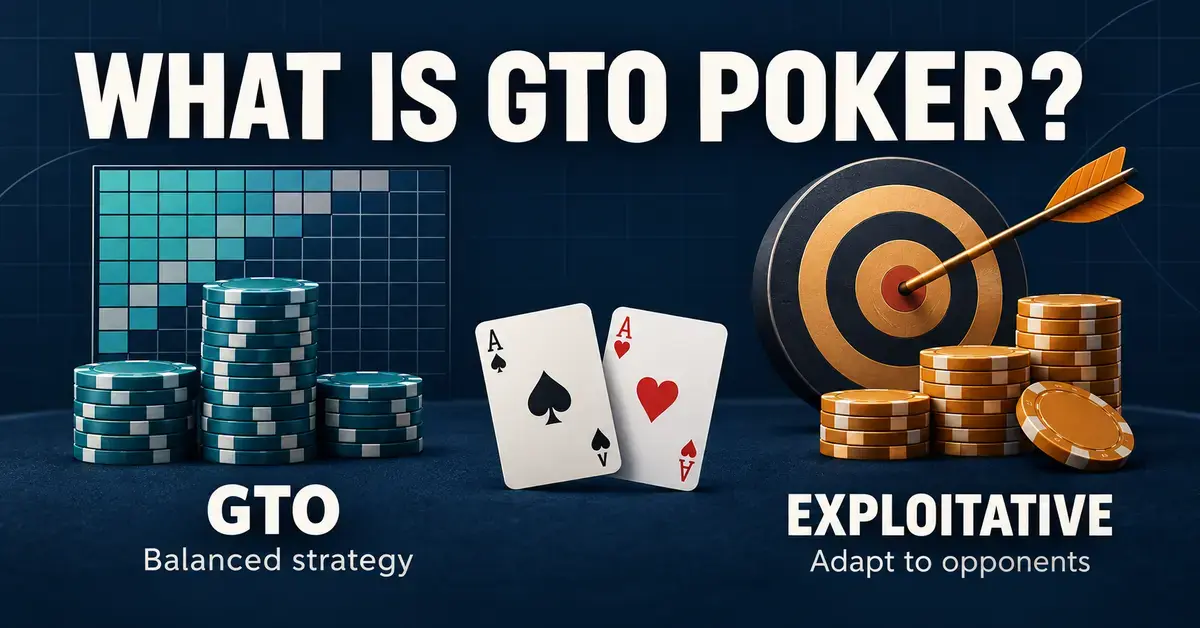
The difference is simple: GTO ignores your opponent and plays a balanced, unexploitable baseline, while exploitative play deliberately deviates from that baseline to punish a specific opponent’s mistakes. This contrast is the heart of modern poker strategy, and it was laid out in detail as far back as the 2006 classic The Mathematics of Poker.
GTO vs Exploitative Play
| Aspect | GTO (Game Theory Optimal) | Exploitative |
|---|---|---|
| Core idea | Play a balanced, unexploitable strategy | Adjust to attack the opponent’s specific mistakes |
| Reacts to opponents? | No — same strategy against everyone | Yes — changes with each opponent |
| Strongest against | Tough, studied or unknown opponents | Weak, predictable or imbalanced opponents |
| Main risk | Leaves money on the table versus weak players | Can be counter-exploited if your read is wrong |
| Long-run floor | Break-even or better; cannot be beaten | Can lose money if your reads are wrong |
| Best use | Default baseline, high stakes, heads-up | Low and mid stakes versus recreational players |
What is exploitative play?
Exploitative play means adjusting your strategy to attack the particular leaks in front of you. If an opponent folds too often, you bluff them relentlessly. If they never fold, you stop bluffing and bet only strong hands for value. Exploitative play can earn far more than GTO against weak or predictable players — but every deviation you make also opens a door: a sharp opponent can notice your adjustment and counter-exploit it. GTO closes that door by never deviating in the first place.
Which approach makes more money?
Against weak or unknown recreational players, exploitative play almost always wins more, because most of the money in poker comes from opponents’ mistakes and pure GTO leaves those mistakes unpunished. Against strong, studied regulars, GTO is the safer choice because there are few mistakes to exploit and any deviation can be turned against you. Most winning players use GTO as a default baseline and then layer targeted exploitative adjustments on top when they have reliable reads. Understanding equilibrium first makes those deviations sharper, because you can see exactly where — and how far — you are moving away from balance.
How does GTO poker work in practice?
In practice, GTO works by building balanced ranges — the full set of hands you would play a given way — so that every betting line contains a healthy mix of strong hands and bluffs. A balanced range makes your opponent indifferent: no matter whether they call or fold, their result is the same, so they cannot gain by guessing. GTO strategies often use mixed strategies too, where the same hand is played one way part of the time and another way the rest of the time (for example, raising a hand 70% of the time and just calling 30%). That randomness is deliberate — it keeps your overall frequencies impossible to read.
Minimum defense frequency (MDF) and alpha
Minimum defense frequency (MDF) is the share of your range you must continue with when facing a bet so that your opponent cannot profit by bluffing any two cards. It follows directly from pot odds and is calculated as:
- MDF = Pot ÷ (Pot + Bet)
- Alpha = Bet ÷ (Pot + Bet) — the fraction of the time a bluff needs you to fold in order to break even.
MDF and alpha always add up to 100%. If an opponent bets $50 into a $100 pot, MDF is 100 ÷ 150 = 66.7%, so you must defend (call or raise) with at least two-thirds of your range. Fold more often than alpha (33.3% here) and their bluffs become automatically profitable. MDF is a guideline rather than an iron law — out of position, or when your opponent’s range is much stronger than yours, defending the full MDF can cost you money.
Value-to-bluff ratios
On the river, GTO also dictates how many bluffs to mix with your value bets so that a bluff-catcher is exactly indifferent to calling. The larger your bet relative to the pot, the more bluffs you are allowed. The table below shows the standard equilibrium figures for common bet sizes:
| Bet size (share of pot) | Opponent’s MDF | Alpha (fold to profit) | Value : bluff ratio | Bluffs in betting range |
|---|---|---|---|---|
| Half pot (0.5x) | 66.7% | 33.3% | 3 : 1 | 25% |
| Three-quarter pot (0.75x) | 57% | 43% | about 2.3 : 1 | 30% |
| Full pot (1x) | 50% | 50% | 2 : 1 | 33% |
| Overbet (2x pot) | 33.3% | 66.7% | 1.5 : 1 | 40% |
These numbers assume a polarized river range (strong value hands plus pure bluffs) in a heads-up pot. They are a foundation, not a script — multiway pots, draws still to come and board texture all shift the right mix.
What are poker solvers, and how do they find GTO?
Poker solvers are software programs that compute near-equilibrium strategies for a specific situation you define, returning the exact frequencies for betting, raising, calling and folding. Popular tools include PioSolver (a postflop solver for no-limit Texas Hold’em) and the cloud-based trainer GTO Wizard, which serves precomputed solutions through a browser.
Under the hood, most solvers use an algorithm called counterfactual regret minimization (CFR). The solver plays the same spot against itself millions of times, tracking how much better it could have done by choosing a different action, then nudges its strategy toward those better choices. After enough iterations the strategy converges on the Nash equilibrium. Solvers report how close they are as an “exploitability” percentage; most players stop at roughly 0.5% to 1%, which is accurate enough to study. Two caveats matter: a solver only answers the exact question you ask (the stacks, bet sizes and ranges you feed it), and it assumes both players understand the solution perfectly — something real opponents rarely do.
A short history of GTO poker
The game-theory approach is older than the solver era. The 2006 book The Mathematics of Poker by Bill Chen and Jerrod Ankenman, published by ConJelCo, introduced many players to equilibrium thinking and the explicit split between optimal and exploitative play. Chen holds a PhD in mathematics from UC Berkeley, and the book remains a foundational reference.
The computing breakthroughs followed. In January 2015, the University of Alberta’s Computer Poker Research Group announced in the journal Science that heads-up limit Texas Hold’em was “essentially weakly solved” by a program called Cepheus. In 2017, Libratus — built at Carnegie Mellon University by Tuomas Sandholm and Noam Brown — defeated four professionals across 120,000 hands of the far larger heads-up no-limit game. Then in July 2019, Pluribus, a joint Carnegie Mellon and Facebook AI project, became the first bot to beat elite pros in six-player no-limit Hold’em, the format most people actually play.
How do you start studying GTO poker?
Start with solid fundamentals before touching a solver. You cannot make sense of equilibrium output without first knowing the rules of poker, hand values and the basics of position and ranges covered in any guide to core poker strategy. Once those are second nature, a practical study path looks like this:
- Learn the vocabulary. Terms like range, polarization, blocker and indifference recur constantly; a good poker terms glossary keeps you from getting lost.
- Use a trainer, not just a solver. Tools such as GTO Wizard quiz you on real spots and show how far your choice was from equilibrium, which teaches patterns faster than reading raw output.
- Study concepts, not memorized charts. Aim to understand why the solver bets big with a polarized range, so you can apply the idea to spots you have never drilled.
- Review your own hands. Run spots you misplayed through a solver afterward and compare, rather than trying to recall exact frequencies mid-hand.
- Build simple baselines. Memorize a handful of anchors — MDF for common bet sizes, river bluff ratios — and reason outward from them at the table.
Common GTO mistakes
The most common mistake is playing textbook GTO against weak opponents instead of exploiting them. Equilibrium is designed to stop a good player from beating you; against a recreational player who folds too much or calls everything, refusing to deviate leaves money on the table. Other frequent errors include:
- Memorizing solver output without understanding it. Frequencies copied blindly fall apart the moment the situation changes slightly.
- Over-bluffing because “GTO bluffs a lot.” The right bluff frequency is tied to bet size and range; bluffing more than equilibrium is just a leak.
- Applying heads-up solutions to multiway pots. Most solver solutions assume one opponent; three-way and four-way spots behave very differently.
- Ignoring rake and real stakes. At small stakes, the rake can change which hands are even profitable to play, something pure equilibrium ignores.
- Forgetting live information. Timing tells, bet-sizing habits and physical reads are exploitable edges that a solver, by design, never uses.
Who is GTO poker for?
GTO is most valuable for serious players who regularly face tough, studied opponents — mid-to-high-stakes cash games, heads-up matches and deep tournament play, where exploitable leaks are rare and reliable reads are hard to come by. For these players, a balanced baseline is a genuine shield. Casual and beginning players usually get a bigger return from mastering fundamentals — position, starting hands and bankroll discipline — and from spotting the obvious mistakes of other recreational players, before investing heavily in equilibrium study. GTO is best understood as a reference point that makes the rest of your decision-making sharper, not a rulebook to follow mechanically on every street.
Responsible play
This article explains poker theory for educational purposes only; it is not betting advice, and no strategy — GTO or exploitative — can guarantee a profit. Poker involves real financial risk and short-term results are highly variable. Play only with money you can afford to lose, set limits before you start, and never chase losses. If gambling stops being fun or feels out of control, free confidential support is available from BeGambleAware and, in the United States, the National Council on Problem Gambling.
Sources
- University of Alberta — Researchers Solve Heads-up Limit Texas Hold’em Poker (Cepheus, 2015)
- Carnegie Mellon University — CMU, Facebook AI Beats Professionals in Six-Player Poker (Pluribus, 2019)
- PokerNews — Pluribus: First AI to Beat Humans in Multiplayer No-Limit Hold’em
- arXiv — Minimum Defense Frequency and the Fundamental Rule of Poker Strategy
- MIT — Lecture Notes on Counterfactual Regret Minimization (CFR)
- PokerNews — Book Review: The Mathematics of Poker (Chen & Ankenman, 2006)
Frequently Asked Questions (FAQ)
Does GTO poker guarantee you will win?
No. A perfect GTO strategy guarantees you cannot be beaten in the long run in a heads-up game, which means at worst you break even. You profit only when opponents deviate from equilibrium. Against weak players, deliberately exploiting their mistakes usually earns more than pure GTO.
Is GTO poker only for Texas Hold’em?
No. Game theory applies to every poker variant, and equilibrium concepts like balance, minimum defense frequency and bluff ratios hold across games. However, most solvers and training tools focus on no-limit Hold’em because it is the most popular format, so ready-made solutions are easiest to find there.
Do I need to be good at maths to play GTO?
Not really. You need to understand a few simple ratios — such as pot odds, minimum defense frequency and value-to-bluff ratios — but the heavy calculation is done by solvers. The harder skill is conceptual: knowing why a balanced range works and when to deviate from it.
Is using a poker solver cheating?
Studying with a solver away from the table is legal and standard practice among serious players. Using any software to get real-time advice while you play an online hand is against the rules of every major poker site and is considered cheating.
What is the difference between GTO and exploitative play in one sentence?
GTO plays the same unexploitable, balanced strategy regardless of the opponent, while exploitative play changes its strategy to attack the specific mistakes a particular opponent is making.
