
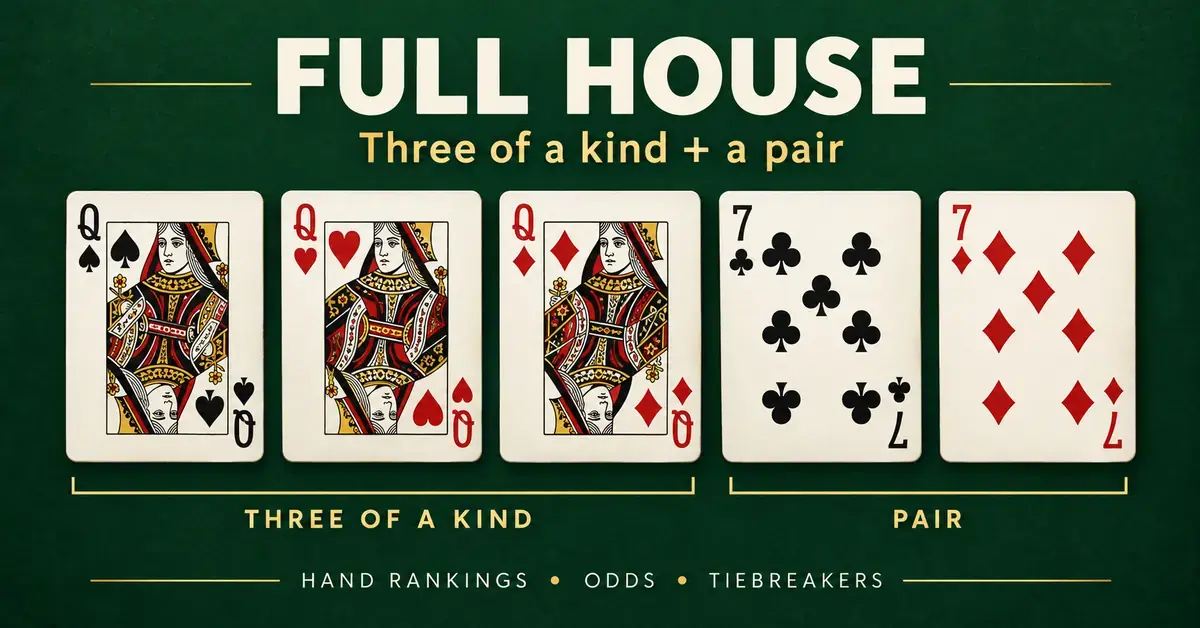
A full house is a five-card poker hand made of three cards of one rank and two cards of another rank — for example three queens and two sevens. It is one of the strongest hands you can hold, sitting just below four of a kind and above a flush. Players also call it a “boat” or “full boat”. This guide explains what a full house is, exactly how it ranks against every other hand, how to read and name one, the tiebreaker rules when two players both have one, and the real odds of making a full house in both five-card and Texas Hold’em (seven-card) poker.
Key Facts
| What it is | Three of a kind plus a pair (five cards used) |
|---|---|
| Also known as | Boat, full boat |
| Rank among all hands | 4th strongest (below four of a kind, above a flush) |
| Beaten by | Four of a kind, straight flush, royal flush |
| Beats | Flush, straight, three of a kind, two pair, pair, high card |
| 5-card combinations | 3,744 out of 2,598,960 |
| 5-card probability | ~0.1441% (about 693 to 1) |
| Texas Hold’em (7-card) probability | ~2.60% (about 1 in 38) |
| Tiebreaker | Higher three of a kind first, then higher pair |
What is a full house in poker?
A full house is a hand that combines three of a kind (also called trips or a set) with one pair. All five cards are used, so you are holding three matching cards of one rank and two matching cards of a second rank. The suits do not matter for a full house — only the ranks count.
Here are three valid examples:
- K♠ K♥ K♦ 9♠ 9♣ — three kings and two nines.
- 5♠ 5♥ 5♣ J♦ J♥ — three fives and two jacks.
- A♠ A♦ A♣ 2♥ 2♠ — three aces and two twos.
If you ever want to see where this hand fits among all ten standard hands, our full poker hand rankings chart lays them out from royal flush down to high card.
How does a full house rank?
A full house is the fourth-strongest hand in standard poker. Only three hands beat it. From strongest down, the hands immediately around a full house are:
- Royal flush — the best possible hand.
- Straight flush — five cards in sequence, all one suit.
- Four of a kind — four cards of the same rank.
- Full house — three of a kind plus a pair.
- Flush — five cards of one suit, not in sequence.
What beats a full house?
Three hands beat a full house: four of a kind, a straight flush, and a royal flush. All three are rarer than a full house, which is exactly why they outrank it. In a 52-card deck there are only 624 ways to make four of a kind and 40 ways to make a straight flush (including the four royal flushes), compared with 3,744 ways to make a full house.
What does a full house beat?
A full house beats every hand below it: a flush, a straight, three of a kind, two pair, one pair and high card. This is the point many beginners get wrong — a full house beats a flush and a straight, even though a flush can look more impressive. The reason is purely mathematical: there are more ways to make a flush (5,108 combinations) or a straight (10,200) than a full house (3,744), so the rarer full house ranks higher.
Hand Comparison
| Hand | Description | 5-card combinations | Beats a full house? |
|---|---|---|---|
| Royal flush | A-K-Q-J-10, one suit | 4 | Yes |
| Straight flush | Five in sequence, one suit | 36 | Yes |
| Four of a kind | Four cards of one rank | 624 | Yes |
| Full house | Three of a kind plus a pair | 3,744 | — |
| Flush | Five of one suit, not in sequence | 5,108 | No |
| Straight | Five in sequence, mixed suits | 10,200 | No |
| Three of a kind | Three cards of one rank | 54,912 | No |
How do you read and name a full house?
Full houses are named with the phrase “X full of Y”, where X is the rank you hold three of and Y is the rank you hold a pair of. The three-of-a-kind part is always said first because it is the part that decides most ties.
- Three aces and two kings = “aces full of kings”.
- Three sevens and two queens = “sevens full of queens”.
- Three tens and two tens is impossible — that would be five of a kind, which does not exist in a standard single-deck game.
So if you hold A♠ A♦ A♣ K♥ K♠, you have aces full of kings. If you hold K♠ K♥ K♦ A♣ A♠, you have kings full of aces. Those two hands are not equal, as the next section explains.
How do full house tiebreakers work?
When two players both make a full house, the winner is decided by the rank of the three of a kind first. The pair only matters if the trips are identical, which can happen in community-card games where everyone shares the board.
The tiebreaker order is:
- Higher three of a kind wins. Aces full of twos (A-A-A-2-2) beats kings full of queens (K-K-K-Q-Q), because three aces beat three kings. The pair is irrelevant here.
- If the trips are equal, the higher pair wins. Eights full of kings (8-8-8-K-K) beats eights full of fours (8-8-8-4-4).
- If both the trips and the pair are equal, the pot is split. This is common in Texas Hold’em when the full house is built mostly from the shared board.
So “aces full of kings” beats “kings full of aces” comfortably — three aces outrank three kings, and the pair never gets a vote. For more on exact-tie situations and how chips are divided, see our explainer on what happens when two hands tie in poker.
What are the odds of a full house?
The odds depend on how many cards you see. In a classic five-card game you are drawing a single five-card hand; in Texas Hold’em you make the best five-card hand out of seven cards (two in your hand and five on the board), so full houses are much more common.
Odds of being dealt a full house in five cards
Out of the 2,598,960 possible five-card hands in a 52-card deck, exactly 3,744 are full houses. That gives a probability of about 0.1441%, or roughly 693 to 1 against. The 3,744 figure comes from the math: 13 choices for the three-of-a-kind rank × 4 ways to pick three of those four cards × 12 remaining ranks for the pair × 6 ways to pick two of those four cards (13 × 4 × 12 × 6 = 3,744).
Counted by rank rather than by suit combination, there are 156 distinct full houses (13 possible trip ranks × 12 possible pair ranks), from “twos full of threes” up to “aces full of kings”.
Odds of making a full house in Texas Hold’em (seven cards)
Across all seven cards in Texas Hold’em, you will end up with a full house roughly 2.60% of the time — about 1 hand in 38. That is far more often than in five-card poker, because two extra cards and a shared board give you many more ways to pair the board or hit a set.
If you want to calculate your chances during a hand rather than over the long run, our guide to poker odds and probability covers outs, pot odds and the quick rule of 2 and 4.
What are the common paths to a full house?
Most full houses in Hold’em come from one of a few familiar situations:
- Flopping a set from a pocket pair. Starting with a pair such as 8-8, you will flop a full house outright only about once in 102 deals (roughly 0.98%).
- Flopping a set, then filling up. When you flop three of a kind with a pocket pair, you have about a 1-in-3 chance of improving to a full house or four of a kind by the river.
- Flopping two pair. From two pair on the flop, you fill up to a full house by the river about 16% of the time (either of your two ranks pairing the board).
- A paired board. When the community cards themselves contain a pair, anyone holding a matching card or an over-pair can complete a full house.
Full house in different poker variants
A full house works the same way in every mainstream poker game, but how often it appears — and how strong it is — changes with the format.
- Texas Hold’em. The shared board means full houses often form on paired boards. A full house is usually a monster here, but on a double-paired board several players can hold one, so the trips rank matters a lot.
- Omaha. In Omaha you receive four hole cards but must use exactly two of them with three from the board. Full houses are far more common in Omaha, so a “small” full house is much less safe than it would be in Hold’em.
- Seven-card stud. With seven individual cards and no shared board, full houses occur at a similar overall rate to Hold’em but are harder to read, since opponents’ cards are partly hidden.
- Five-card draw. Here the five-card odds apply directly — a full house is a rare and powerful holding, dealt or drawn only about once every 700 hands.
If you are still learning the betting rounds and showdown mechanics behind all of these, start with our step-by-step guide on how to play poker.
Example: a full house in a Texas Hold’em hand
A worked example makes the naming and tiebreaker rules concrete. Suppose you hold 8♠ 8♥ in Texas Hold’em and the five community cards come 8♦ Q♣ Q♥ 3♠ K♦.
- Your three eights (two in hand, one on the board) combine with the pair of queens on the board.
- Your best five-card hand is 8-8-8-Q-Q — eights full of queens.
- You do not have “queens full of eights”: you only hold one queen’s worth of pair from the board, while your own cards give you the three eights.
Now imagine an opponent holds Q♠ 3♥. They make three queens with the board pair plus their own queen, and their pair is the threes: queens full of threes (Q-Q-Q-3-3). Even though your eights full looks modest, you lose this pot — three queens beat three eights, so the trips rank decides it before the pair is ever compared. This is exactly why a “small” full house on a paired board should be played with care.
What are the most common full house mistakes?
A full house is strong, but it is not automatically a winner. These are the errors that cost players the most:
- Assuming a full house is unbeatable. It still loses to four of a kind, a straight flush and a royal flush. On a paired board, four of a kind is a real threat.
- Overvaluing a small full house. “Fives full” on a board that could easily give an opponent a bigger boat is far weaker than it feels. The trips rank decides ties, so a low set with a high board pair can be dominated.
- Misreading which full house you hold. On a double-paired board (for example 9-9-4-4-K), your best five cards may be the board’s higher pair plus your card, not the combination you first picture. Always build the highest possible five-card hand.
- Confusing the tiebreaker. Remember the three of a kind is compared first, then the pair — not the other way round.
- Forgetting the Omaha rule. In Omaha you must use exactly two hole cards; you cannot “play the board” for a full house the way you can in Hold’em.
Sources
Frequently Asked Questions (FAQ)
Is a full house better than a flush?
Yes. A full house beats a flush in standard poker. A flush can be made 5,108 ways versus only 3,744 ways for a full house, and the rarer hand always ranks higher. A full house also beats a straight and three of a kind.
What beats a full house in poker?
Only three hands beat a full house: four of a kind, a straight flush and a royal flush. Everything else — flush, straight, three of a kind, two pair and below — loses to it.
Which full house wins if two players both have one?
The player with the higher three of a kind wins, regardless of the pair. For example, aces full of twos beats kings full of queens. If the trips are identical, the higher pair wins; if both are identical, the pot is split.
What are the odds of getting a full house?
Being dealt a full house in five cards is about 0.1441%, or roughly 693 to 1. In Texas Hold’em, where you use the best five of seven cards, you make a full house about 2.60% of the time.
Why is a full house called a boat?
“Boat” and “full boat” are common nicknames for a full house. The origin is informal poker slang; both terms mean exactly the same hand — three of a kind plus a pair.
