
A straight in poker is any five cards of consecutive rank that are not all the same suit — for example 6-7-8-9-10 using a mix of hearts, spades and clubs. It sits in the middle of the poker hand rankings, beating three of a kind and two pair but losing to a flush and everything above it. The most common questions about the straight are about the ace: can it be both the highest and the lowest card, and can it “wrap around” the top of the deck? This guide answers those directly, lists every possible straight, shows how often one actually appears, and explains the draws that let you chase one.
Key Facts
| Hand | Straight — five consecutive cards, mixed suits |
|---|---|
| Rank | 6th of 10 (beats three of a kind, loses to a flush) |
| Highest straight | A-K-Q-J-10 (“Broadway”) |
| Lowest straight | 5-4-3-2-A (“the wheel”) |
| Ace rule | Plays high or low, never both — no wrap-around |
| Possible straights | 10 distinct top cards |
| Combinations | 10,200 (0.3925% of hands) |
| Odds of being dealt | About 254 to 1 |
| Tie-breaker | Highest top card; equal straights split the pot |
What is a straight in poker?
A straight is five cards of consecutive rank in any mix of suits. The ranks must run in an unbroken sequence — 5-6-7-8-9, for example — but the suits do not matter, which is the one rule that separates a straight from the stronger hands above it.
Two conditions have to be met:
- Five cards in a row by rank. There can be no gaps. 4-5-6-7-9 is not a straight; it is 9-high nothing.
- Not all the same suit. If all five consecutive cards share one suit, the hand is upgraded to a straight flush, which is a far rarer and much stronger holding.
A straight is named by its highest card. 7-8-9-10-J is a “jack-high straight,” and 8-9-10-J-Q is a “queen-high straight.” When two players both make a straight, that top card is what decides the winner.
Where does a straight rank among poker hands?
A straight is the sixth-strongest hand in standard poker, out of ten categories. It is stronger than a high card, one pair, two pair and three of a kind, and weaker than a flush, a full house, four of a kind, a straight flush and a royal flush.
The ranking is driven by rarity: the harder a hand is to make, the higher it sits. A straight beats three of a kind because a straight is rarer across a full 52-card deck. For the same reason a flush beats a straight — a flush (five cards of one suit) is slightly less likely than a straight, so it ranks one place higher. This is the single most common point of confusion at beginner tables, so it is worth memorising: when a straight and a flush collide, the flush wins.
Here is the straight’s exact neighbourhood in the order:
- Flush — beats a straight
- Straight — five cards in sequence, mixed suits
- Three of a kind — loses to a straight
Ace-high and ace-low: how the ace works in a straight
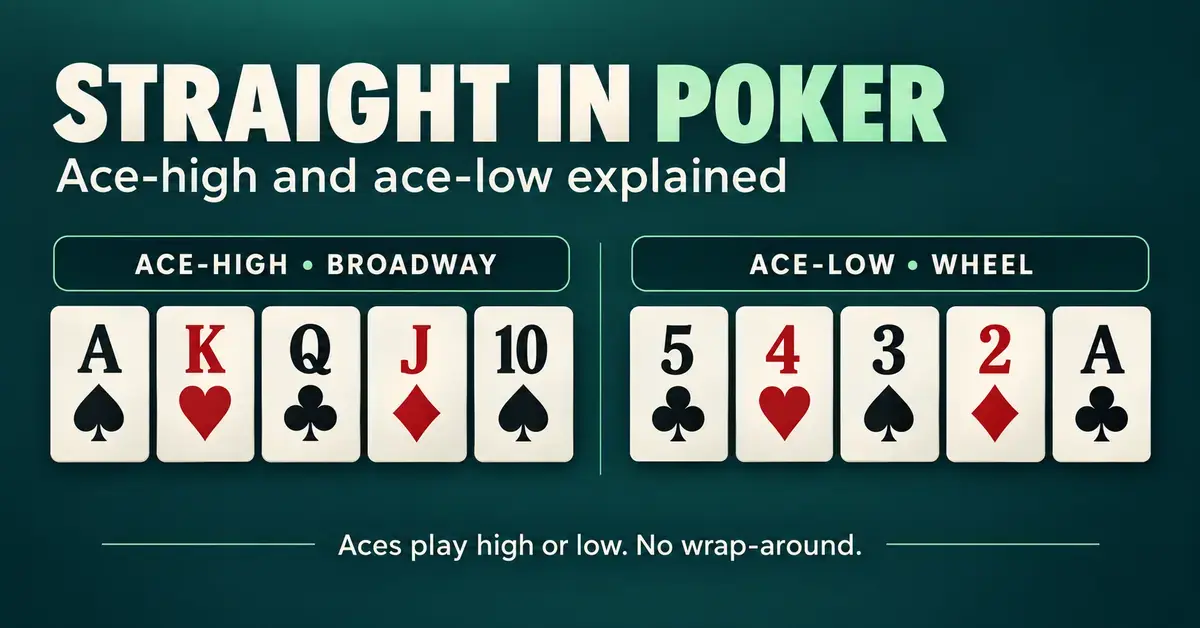
The ace is the only card that can sit at either end of a straight, and understanding this is the key to the whole hand. The ace plays high above the king, or low below the two — but it can only do one of those jobs at a time, never both in the same five cards.
Ace-high straight (Broadway)
When the ace is the top card, the straight runs A-K-Q-J-10. This is the highest possible straight and it has its own nickname: Broadway. Because the ace is acting as the highest card, Broadway beats every other straight in a showdown.
Ace-low straight (the wheel)
When the ace drops below the two, the straight runs 5-4-3-2-A, usually written A-2-3-4-5. Here the ace counts as a “one,” so the hand is only five-high. This is the lowest possible straight and it is nicknamed the wheel or the bicycle. A common beginner error is to assume the ace still makes this a strong hand — it does not. The wheel is the weakest straight there is and loses to every straight from 6-high upward.
Why there is no wrap-around straight
The ace cannot be used in the middle of a sequence to bridge the top and bottom of the deck. Q-K-A-2-3 is not a straight, and neither is K-A-2-3-4. The ace is either the card above the king or the card below the two — the sequence is not a loop. This “no wrap-around” rule applies in Texas Hold’em, Omaha, Seven-Card Stud and virtually every mainstream poker variant. If you ever see a game that allows wrap-around straights, it is a non-standard house rule, not the norm.
What are all the possible straights?
There are exactly ten different straights, ranked here from highest to lowest by their top card. Each one can be made in any mix of suits.
- A-K-Q-J-10 — ace-high (Broadway), the strongest
- K-Q-J-10-9 — king-high
- Q-J-10-9-8 — queen-high
- J-10-9-8-7 — jack-high
- 10-9-8-7-6 — ten-high
- 9-8-7-6-5 — nine-high
- 8-7-6-5-4 — eight-high
- 7-6-5-4-3 — seven-high
- 6-5-4-3-2 — six-high
- 5-4-3-2-A — five-high (the wheel), the weakest
Because the top card alone decides the ranking, a higher straight always beats a lower one regardless of the smaller cards. A ten-high straight (10-9-8-7-6) beats a nine-high straight (9-8-7-6-5) every time.
How rare is a straight in poker?
A straight is a genuinely strong made hand. In a random five-card deal there are 10,200 distinct straights (counting only those that are not straight flushes), which works out to 0.3925% of all possible five-card hands — odds of about 254 to 1 against. Put simply, you will be dealt a straight roughly once in every 254 random five-card hands.
In Texas Hold’em the numbers look different because you see seven cards and choose your best five. If you hold two “connectors” (touching cards such as J-10 down to 5-4), the chance of flopping a completed straight is only about 1.3%, or 1 in 76. You are far more likely to flop a draw — about 9.7% of the time, roughly 1 in 10 — and then try to complete it on the turn or river. For the full method of turning outs into percentages, see our guide to poker odds and the rule of 2 and 4.
Straight vs straight: who wins a tie?
When two players both have a straight, the higher top card wins — and there are no kickers to consider. A straight uses all five cards to form the sequence, so nothing is left over to break a tie beyond the top card itself.
- Different top cards: the higher straight wins. K-Q-J-10-9 beats Q-J-10-9-8.
- Identical straights: the pot is split evenly. This happens often in Hold’em when the straight is formed mostly or entirely from the community cards, so both players “play the board.”
Suit never breaks a straight tie in standard poker — there is no “hearts beats spades.” For the wider rules on chopped pots and matched hands, see what happens when two hands tie in poker.
Straight draws: open-ended vs gutshot
Most straights in flop games arrive as draws — four cards to a straight that still need one more. How many cards complete the draw (your “outs”) depends on the shape of those four cards.
Straight Draws Compared
| Draw type | Example (your cards / board) | Outs | Chance by river (from flop) |
|---|---|---|---|
| Open-ended | J-9 on 10-8-2 (need 7 or Q) | 8 | ~31.5% |
| Double gutshot | Two inside cards completing different straights | 8 | ~31.5% |
| Gutshot (inside) | Q-J on 10-8-2 (need 9) | 4 | ~16.5% |
Open-ended straight draw
An open-ended straight draw (OESD) has four cards in a row and can be completed at either end, giving eight outs. If you hold J-9 on a 10-8-2 board, any 7 or any queen makes your straight — four sevens and four queens, eight cards in all. From the flop, an open-ended draw completes by the river about 31.5% of the time (roughly 1 in 3).
Gutshot (inside) straight draw
A gutshot, also called an inside straight draw, is missing a card in the middle of the sequence, so only one rank completes it — four outs. Holding Q-J on a 10-8-2 board, only a 9 fills the gap. From the flop, a gutshot completes by the river about 16.5% of the time, or roughly 1 in 6 — half as often as an open-ended draw, which is why aggressive play with a bare gutshot is usually a mistake.
Double gutshot
A double gutshot (or double-belly-buster) is a disguised draw where two separate inside cards each complete a different straight. It also gives eight outs, the same as an open-ended draw, but it is harder for opponents to read because the completing cards do not sit neatly on both ends.
Straights in Texas Hold’em and Omaha
In Texas Hold’em you make a straight from any five of the seven available cards — your two hole cards plus the five community cards. You might use both hole cards, one, or occasionally none at all if the straight is entirely on the board, in which case everyone still in the hand shares it.
In Omaha the rule is stricter: you must use exactly two of your four hole cards and exactly three community cards. That changes which straights are possible and means you cannot “play the board” for a straight the way you can in Hold’em. If you are learning the differences between games, our overview of the rules of poker walks through betting rounds and showdowns step by step.
Common mistakes with straights
The straight is a strong hand, but it traps beginners in predictable ways. Watch for these:
- Forgetting a flush beats it. When three or four cards of one suit are on the board, your straight can be second-best. Slow down when a flush is possible.
- Playing the “idiot end.” On an open-ended draw you can make the low end of the straight while an opponent makes the high end with the same board. The low end — the “idiot end” or “sucker straight” — loses the whole pot. Favour draws to the high end.
- Overvaluing the wheel. A-2-3-4-5 is only five-high and loses to every higher straight. The ace does not make it strong.
- Chasing a bare gutshot. Four outs is only about a 1-in-6 shot by the river from the flop; calling big bets with it bleeds chips.
- Assuming aces wrap. Q-K-A-2-3 is not a straight. If you need the ace, it is either high or low, not both.
Reading the board quickly for the “nuts” — the best possible hand — is a core skill; our poker strategy guide covers how position and board texture should change the way you play a straight or a straight draw. If any term here is new, the A-Z poker glossary defines it in plain English.
Responsible play
This article explains the rules and odds of a poker hand for information only; it is not betting advice, and knowing the odds does not guarantee a winning session. Poker played for real money carries financial risk, and no hand, draw or strategy changes the fact that outcomes are uncertain. Only gamble with money you can afford to lose, play only where you are of legal age, and set limits before you start. If gambling is causing you or someone you know harm, free and confidential support is available from GambleAware and, in the United States, the National Council on Problem Gambling helpline on 1-800-522-4700.
Sources
Frequently asked questions (FAQ)
Does a straight beat a flush in poker?
No. A flush beats a straight. A flush (five cards of the same suit) is slightly rarer than a straight, so it ranks one place higher. A straight only beats hands below it: three of a kind, two pair, one pair and high card.
Can an ace be high and low in the same straight?
No. The ace can be the highest card in A-K-Q-J-10 or the lowest card in A-2-3-4-5, but never both in the same five cards. There is no wrap-around straight, so Q-K-A-2-3 and K-A-2-3-4 are not valid straights.
What is the highest straight in poker?
The highest straight is A-K-Q-J-10, known as Broadway. It is an ace-high straight and beats every other straight. The lowest straight is 5-4-3-2-A, called the wheel, which is only five-high.
How many outs does a straight draw have?
An open-ended straight draw has eight outs because either end completes it, and it hits by the river about 31.5% of the time from the flop. A gutshot (inside) draw has only four outs and hits about 16.5% of the time.
What happens if two players make the same straight?
If both players have the same straight by top card, the pot is split evenly. The higher top card wins when they differ, and suits never break the tie. Identical straights are common in Hold’em when the sequence comes mostly from the shared community cards.
