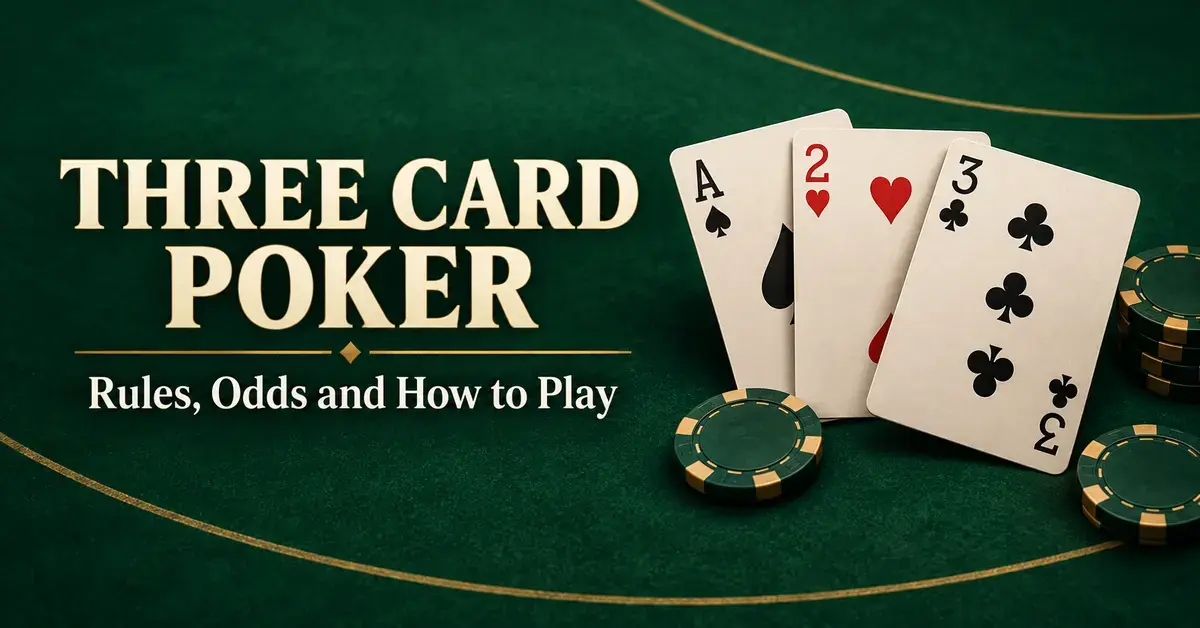
Three Card Poker is a fast casino table game in which you use just three cards to beat the dealer, with only one decision to make after you see your hand: play or fold. It is not played against other players like Texas Hold’em; instead you bet against the house, which makes it one of the easiest card games on a casino floor to learn. This guide covers the rules, the hand rankings (a straight really does beat a flush here), the Pair Plus and Ante Bonus side bets, the real odds and house edge, and the simple strategy that keeps your losses as low as possible.
Quick Facts
- Game type: House-banked casino table game (you play against the dealer)
- Based on: Three-card brag
- Invented by: Derek Webb, 1994 (patented 1997)
- Deck: Single standard 52-card deck
- Cards per hand: 3 (no drawing or swapping)
- Main bets: Ante & Play; optional Pair Plus and 6 Card Bonus
- Dealer qualifies on: Queen high or better
- Decisions per hand: One — play or fold
- House edge (Ante, optimal play): about 3.37% (~2.01% element of risk)
- Optimal strategy: Play Queen-Six-Four or better, fold the rest
What is Three Card Poker?
Three Card Poker is a house-banked casino game played with a single standard 52-card deck, where each player and the dealer receive three cards and the best three-card hand wins. “House-banked” means you are playing against the casino rather than against the people sitting next to you, so everyone at the table can win or lose independently in the same round.
The game was designed in 1994 by English card-room operator Derek Webb, who wanted a poker-style game that dealt as quickly as blackjack or baccarat. He combined three goals: rules simple enough for anyone to pick up in a minute, payouts big enough to attract players, and a house edge high enough that casinos would want it on the floor. Webb based the game on the traditional British game three-card brag and first marketed it as “Casino Brag” through his company Prime Table Games. It was renamed Three Card Poker when it reached the United States, and in 1999 the rights outside the British Isles were acquired by Shuffle Master (later SHFL Entertainment). It has since become one of the most widely spread proprietary table games in the world and is a staple of online casinos too.
Because the hand is only three cards, the probabilities differ from standard five-card games. If you already know the standard poker hand rankings, note that Three Card Poker reshuffles them, which is one of the first things new players get wrong.
Three Card Poker rules: how a hand plays out
A round of Three Card Poker follows the same short sequence every time. The whole hand hinges on a single play-or-fold choice, so there is very little to memorise.
Step 1 — Place your opening bets
You start by placing an Ante bet, an optional Pair Plus bet, or both. The Ante is the bet that lets you compete against the dealer. Pair Plus is an independent side bet that pays whenever your three cards make a pair or better, no matter what the dealer holds. You can play the Ante alone, Pair Plus alone, or both at once.
Step 2 — Look at your three cards
The dealer gives you and themselves three cards each. Your cards are dealt face down (the dealer’s stay face down until the showdown), and you simply look at your hand and judge how strong it is. There is no drawing, swapping, or discarding — what you are dealt is your final hand.
Step 3 — Play or fold
Now comes the only decision in the game. If you placed an Ante, you choose to either:
- Play: place a second bet, the Play bet, equal to your Ante, to stay in the hand and see the dealer’s cards.
- Fold: surrender your hand and lose your Ante.
If you folded but also have a Pair Plus bet, that side bet is still settled on its own — folding your Ante does not cancel Pair Plus.
Step 4 — The dealer qualifies (or not)
The dealer turns over their three cards. For the dealer’s hand to “qualify,” it must be Queen high or better — meaning at least a hand whose highest card is a queen. This qualification rule is central to how the Ante and Play bets are paid:
- If the dealer does not qualify (a jack high or worse), your Ante pays even money (1 to 1) and your Play bet is returned to you as a push, regardless of what you are holding.
- If the dealer qualifies and you beat them, both your Ante and your Play bet pay even money.
- If the dealer qualifies and beats you, you lose both the Ante and the Play bet.
- If you tie the dealer, both bets push (no money changes hands).
Step 5 — Bonuses are paid
Finally, any winning side bets or bonuses are paid. The Ante Bonus (for strong player hands) and the Pair Plus bet are both settled on your cards alone, so they can win even when the dealer beats you or fails to qualify. The exact payouts are covered in the sections below.
Three Card Poker hand rankings
Three Card Poker uses six hand categories, and the order is not the same as in five-card poker. Because you only hold three cards, a straight is harder to make than a flush, so a straight beats a flush here — the reverse of Texas Hold’em. From strongest to weakest:
- Straight flush — three cards in sequence, all the same suit (e.g. 9-10-J of hearts).
- Three of a kind — three cards of the same rank.
- Straight — three cards in sequence of mixed suits.
- Flush — three cards of the same suit, not in sequence.
- Pair — two cards of the same rank.
- High card — none of the above; the highest card decides.
The ace can be high (A-K-Q) or low (A-2-3) for a straight. When two hands share the same category, the higher ranks win, exactly as in other types of poker. The table below shows how often each hand appears in a single 52-card deck and what it pays.
Hands, Odds and Payouts
| Hand | Chance (per deal) | Pair Plus (classic) | Ante Bonus |
|---|---|---|---|
| Straight flush | about 1 in 460 | 40 to 1 | 5 to 1 |
| Three of a kind | about 1 in 425 | 30 to 1 | 4 to 1 |
| Straight | about 1 in 31 | 6 to 1 | 1 to 1 |
| Flush | about 1 in 20 | 4 to 1 | — |
| Pair | about 1 in 6 | Even money | — |
| High card | about 3 in 4 | No win | — |
The Pair Plus side bet
Pair Plus is an optional bet that pays whenever your three cards contain a pair or better, win or lose against the dealer. It is popular because it offers the big payouts that make the game exciting — a straight flush can pay 40 to 1 — but it is a separate wager with its own house edge, not a way to improve your main bet.
The original (and most player-friendly) Pair Plus pay table pays 40 to 1 for a straight flush, 30 to 1 for three of a kind, 6 to 1 for a straight, 4 to 1 for a flush and even money for a pair, giving a house edge of about 2.32%. Many casinos now use trimmed versions — for example reducing the flush to 3 to 1, the straight to 5 to 1, or three of a kind to 25 to 1 — which push the house edge up to roughly 5% to 7%. Always read the posted pay table before you sit down, because the numbers vary from table to table and from one online casino to another.
The Ante Bonus
The Ante Bonus rewards you for being dealt a strong hand on your Ante bet, and it is paid even if the dealer beats you or fails to qualify. You do not have to place an extra wager for it — it is built into the Ante. The standard Ante Bonus pays:
- Straight flush: 5 to 1
- Three of a kind: 4 to 1
- Straight: 1 to 1
Because the Ante Bonus always pays on these three hands, it slightly softens the Ante’s house edge and is one reason the game stays reasonably fair when you play correctly.
The 6 Card Bonus and other side bets
Many tables offer a 6 Card Bonus, an optional wager that combines your three cards with the dealer’s three cards to make the best possible five-card hand. It pays on five-card poker rankings — typically from 5 to 1 for three of a kind up to around 1,000 to 1 for a royal flush. The catch is the cost: the 6 Card Bonus carries a very high house edge (commonly around 15%), far worse than the main game, so it is purely an entertainment bet rather than a smart one.
Online and live variants may add other side bets or progressive jackpots with names like “Prime” or “Bonus.” The same rule applies to all of them: the flashier the top prize, the higher the house edge tends to be.
Three Card Poker odds and house edge
The house edge in Three Card Poker depends on which bet you are making. There are 22,100 possible three-card combinations in a 52-card deck, and the frequencies of each hand drive the maths.
- Ante bet: playing the correct strategy, the house edge is about 3.37% of your Ante. Because you usually also post a Play bet, the “element of risk” (the edge measured against the total amount you put at risk) is lower, around 2.01%. That makes the base game competitive with blackjack and baccarat on a per-dollar-bet basis.
- Pair Plus: from about 2.32% on the best pay table up to roughly 7% on reduced ones.
- 6 Card Bonus: commonly around 15% — the worst value on the table.
Understanding these numbers is the same discipline you would apply to poker odds and probability in a skill game: the lower the house edge, the longer your money lasts.
Three Card Poker strategy
The entire optimal strategy for Three Card Poker fits in one sentence: play any hand of Queen-Six-Four or better, and fold everything worse. This threshold, calculated by gambling mathematician Michael Shackleford of Wizard of Odds, is the point at which placing the Play bet loses you less money on average than folding and forfeiting the Ante.
In practice that means:
- Always play if your highest card is an ace or a king, whatever your other two cards are.
- If your highest card is a queen, play when your second card is at least a six — and if it is exactly Q-6, play when your lowest card is a four or higher.
- Fold everything lower than Queen-Six-Four (for example Q-6-3 or any jack-high hand).
Following this rule perfectly costs nothing to learn and keeps the Ante house edge at its minimum. Unlike a true skill game, there is no bluffing, position or bet-sizing to master — which is why Three Card Poker rewards discipline more than poker strategy in the traditional sense.
Common mistakes to avoid
Most money lost at Three Card Poker beyond the built-in house edge comes from a handful of avoidable errors:
- Folding too many hands. Some players fold anything without a pair. The correct threshold is far lower — Queen-Six-Four — so folding decent high-card hands throws away value.
- Playing hopeless hands “to see the dealer’s cards.” Playing below Q-6-4 costs more than it saves. Curiosity is not a strategy.
- Treating Pair Plus as a boost to the main bet. It is a separate wager with its own, often higher, house edge. Betting big on Pair Plus does not improve your odds against the dealer.
- Ignoring the pay table. A flush paying 3 to 1 instead of 4 to 1 on Pair Plus roughly doubles the house edge. Always check the posted odds first.
- Chasing the 6 Card Bonus. Its ~15% edge makes it the most expensive bet on the layout over time.
- Confusing the hand order. Remember a straight beats a flush here; misreading your own hand leads to wrong play-or-fold choices.
Who is Three Card Poker for?
Three Card Poker suits players who want poker’s hand rankings and quick thrills without the study, patience and head-to-head pressure of games like Texas Hold’em. It is a strong first casino card game for beginners because a single rule — play Q-6-4 or better — covers correct play, and the base-game house edge is reasonable. It also appeals to players who enjoy the lottery-style excitement of the Pair Plus and bonus bets, as long as they understand those carry higher edges.
If you prefer games with more decisions per hand, the closely related Four Card Poker deals more cards and plays differently, while classic player-versus-player poker remains the deeper, skill-based alternative where your edge comes from outplaying opponents rather than beating a fixed house margin.
Responsible Gambling
This article is for information only and is not betting advice or encouragement to gamble. Three Card Poker is a house-banked game with a built-in mathematical edge for the casino, so over time the game is designed to win more than it pays out; no strategy, side bet or “system” changes that, and demo or free play does not improve your chances with real money. Only ever gamble with money you can afford to lose, set time and budget limits before you start, and never chase losses. If gambling stops being fun or feels hard to control, free, confidential help is available — in the UK through BeGambleAware and GamCare, and in the US through the National Council on Problem Gambling (helpline 1-800-GAMBLER). You must be of legal gambling age in your jurisdiction to play.
Sources
Frequently Asked Questions (FAQ)
Does a straight beat a flush in Three Card Poker?
Yes. With only three cards, making a straight is harder than making a flush, so a straight outranks a flush — the opposite of five-card games like Texas Hold’em. The full order from best to worst is straight flush, three of a kind, straight, flush, pair, high card.
What is the best hand to fold or play?
Play any hand of Queen-Six-Four or better and fold everything lower. That single threshold is the mathematically optimal strategy, meaning you should play all ace-high and king-high hands and most queen-high hands, but fold hands like Q-6-3 and all jack-high hands.
What does it mean when the dealer does not qualify?
The dealer’s hand only counts if it is Queen high or better. If the dealer fails to qualify, your Ante bet pays even money and your Play bet is returned to you as a push, regardless of your own cards — so a non-qualifying dealer guarantees you at least your Ante back plus a one-to-one win on it.
Is Pair Plus worth betting?
Pair Plus is an optional side bet that pays on a pair or better no matter what the dealer holds. On the best pay table its house edge is about 2.32%, but many casinos use reduced tables that push it to 5%–7%. It offers bigger payouts but does not improve your main bet, so treat it as entertainment and always check the posted odds.
What is the house edge in Three Card Poker?
With correct strategy the Ante bet has a house edge of about 3.37% (roughly 2.01% measured against total money wagered). Pair Plus ranges from about 2.32% to 7%, and the optional 6 Card Bonus is around 15%, making it the worst value on the table.
