
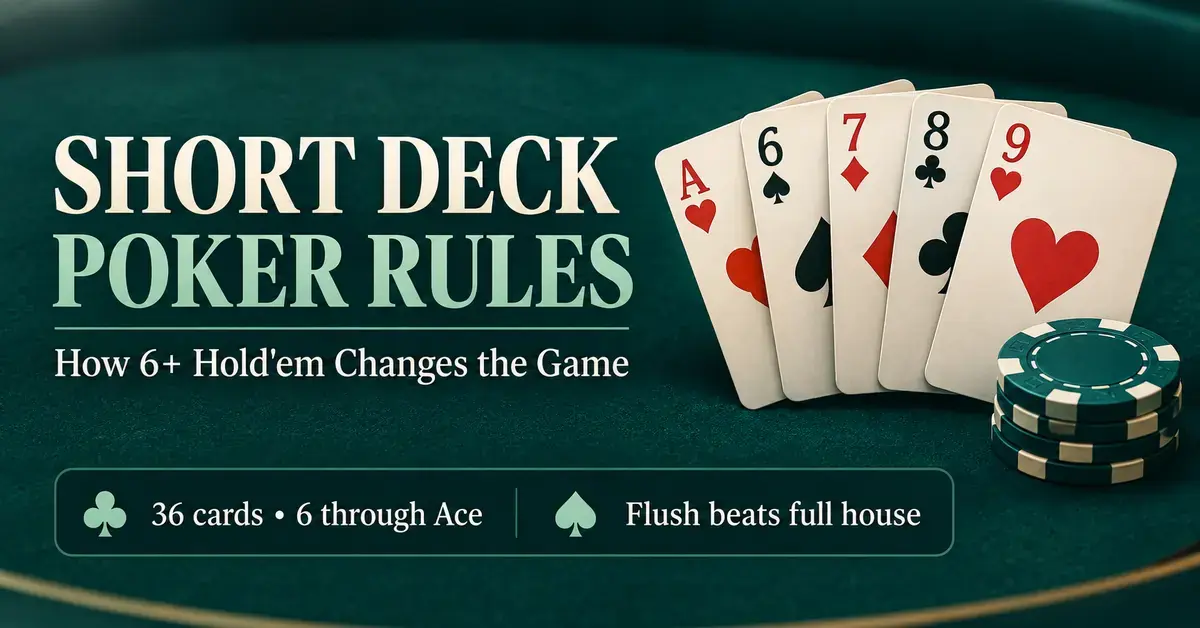
Short deck poker, also known as 6+ Hold’em, is a faster, higher-action cousin of Texas Hold’em played with a 36-card deck instead of the usual 52. The deuces through fives are stripped out, which sounds like a small change but rewrites two things that matter most: the odds of making each hand and, as a direct result, the order in which hands beat one another. The headline surprise is that a flush beats a full house. This guide explains every rule of short deck poker in plain English, shows the math behind the reshuffled hand rankings, walks through the unusual ante-only betting structure, and covers the odds and strategy shifts that make 6+ Hold’em its own game.
Key Facts
| Also known as | 6+ Hold’em, Six Plus Hold’em |
|---|---|
| Deck | 36 cards (6 through Ace); 2s, 3s, 4s and 5s removed |
| Format | No-limit community-card poker, based on Texas Hold’em |
| Key rule | A flush beats a full house |
| Lowest straight | A-6-7-8-9 (no A-2-3-4-5 wheel) |
| Betting structure | Ante-only: every player antes, the button posts a double ante (usually no blinds) |
| Players | Typically 2 to 9 at a table |
| Known for | High action, close equities and more variance than standard Hold’em |
What is short deck poker (6+ Hold’em)?
Short deck poker is a variant of no-limit Hold’em in which the twenty lowest cards — every two, three, four and five — are removed from the deck. That leaves 36 cards running from six up to ace in each of the four suits, which is why the game is also called 6+ Hold’em or “six plus” Hold’em. Everything else about the shape of a hand looks familiar: each player is dealt two private hole cards, five community cards are dealt across a flop, turn and river, and you make the best five-card hand from any combination of the seven available to you.
If you already know No-Limit Texas Hold’em, you know roughly 80% of short deck. The remaining 20% — the deck, the hand rankings and the betting structure — is what this guide focuses on, because getting those wrong is how newcomers lose money fast.
How removing the low cards changes the game
Taking out the 2s through 5s does far more than shrink the deck. With fewer cards and no small ranks, premium holdings and connected boards appear much more often. Two “Broadway” cards (ten or higher) now arrive in roughly 30% of starting hands, more than double the 14% you see in a full deck. Hands collide harder, equities run closer together, and showdowns happen more frequently. The practical effect is a game built for action: bigger pots, more all-ins and far more variance than standard Hold’em.
The tighter card pool also compresses the gap between the best and worst hands preflop. A premium pair is still a favourite against two high cards, but by a smaller margin than it would be in a 52-card deck, so coolers and swings are simply part of the format rather than rare events.
Short deck hand rankings: why a flush beats a full house
The single most important short deck rule is that a flush beats a full house. This is not a house-rule quirk — it is a mathematically correct adjustment to the shorter deck. Each suit now contains only nine cards (6 through ace) instead of thirteen, which makes flushes considerably harder to complete. At the same time, with so many pairs and sets flying around, full houses become easier to make. When a flush is rarer than a full house, it has to rank above it. For a refresher on the standard order this is based on, see our full guide to poker hand rankings.
The standard short deck ranking order
The most widely used short deck ranking, from strongest to weakest, is:
- Royal flush — A-K-Q-J-10, all one suit
- Straight flush — five suited cards in sequence
- Four of a kind — four cards of the same rank
- Flush — five cards of one suit (now above a full house)
- Full house — three of a kind plus a pair
- Straight — five cards in sequence, mixed suits
- Three of a kind — three cards of the same rank
- Two pair
- One pair
- High card
The only change from the standard poker rules is that the flush and full house swap places. Everything above four of a kind and everything below a straight stays exactly where you expect it.
Does three of a kind beat a straight?
This is where short deck is genuinely not standardized, so always confirm the rules before you sit down. In the shorter deck, straights are actually easier to make than three of a kind, which by the same logic that promotes the flush would argue for three of a kind ranking above a straight. Some rooms and early rule sets do rank trips over straights for that reason. However, most online poker rooms and the high-stakes Triton Poker Series keep straights above three of a kind, partly because it preserves more playable, enjoyable situations at the table. Treat the straight-over-trips order as the common default, but never assume it — check the table rules.
Straights and the lowest “wheel”
Aces still play both high and low in short deck, but because the low cards are gone, the lowest possible straight changes. Instead of the familiar A-2-3-4-5 “wheel,” the lowest straight in 6+ Hold’em is A-6-7-8-9, with the ace acting as the card below the six. The ace at the top still completes the top straight 10-J-Q-K-A as normal.
The ante-only betting structure
Short deck is usually dealt with an ante-only structure rather than the small-blind/big-blind setup you know from Hold’em. In the most common format there are no blinds at all. Instead, every player at the table posts a single ante before the cards are dealt, and the player on the button posts a double ante — effectively two antes. That button ante acts a little like a big blind and sets the price of the pot.
This structure rewards position heavily and creates a lot of multiway action, because the dead money in the middle makes it cheap and tempting to see a flop. Understanding it is central to sound poker strategy in this format.
How a hand plays out
- Antes posted: everyone antes once; the button posts a double ante.
- Preflop: action begins with the player to the left of the button, who may call (matching the button’s ante), raise or fold.
- Flop, turn and river: community cards are dealt exactly as in Hold’em, with a betting round after each.
- Showdown: remaining players reveal their hands and the best five-card hand under short deck rankings wins the pot.
Because the first player to enter the pot often gets a very attractive price relative to the antes already in the middle, limping and seeing cheap flops is far more common and more defensible in short deck than in standard No-Limit Hold’em.
Short Deck vs Texas Hold'em
| Feature | Short Deck (6+ Hold’em) | Texas Hold’em |
|---|---|---|
| Deck size | 36 cards | 52 cards |
| Cards removed | 2s, 3s, 4s, 5s | None |
| Flush vs full house | Flush beats full house | Full house beats flush |
| Lowest straight | A-6-7-8-9 | A-2-3-4-5 |
| Betting structure | Ante-only, button double ante | Small blind and big blind |
| Pocket pair frequency | ~1 in 11.7 hands | ~1 in 17 hands |
| Flop a set with a pair | ~17% | ~12% |
| Variance | Higher | Lower |
Short deck odds and probabilities
The shorter deck moves almost every probability, which is why memorized Hold’em odds will mislead you. These figures come from standard combinatorial analysis of the 36-card deck and explain why short deck feels so much more action-packed. For the methods behind them, see our guide to poker odds and probability.
- Being dealt a pocket pair: about once every 11.7 hands (~8.6%), versus roughly once every 17 hands in Hold’em.
- Being dealt pocket aces: about once every 105 hands (~0.95%), versus once every 221 hands in a full deck.
- Two Broadway cards (ten or higher): around 30% of hands, versus about 14% in Hold’em.
- Flopping a set with a pocket pair: about 17%, up from roughly 12% in Hold’em.
- Completing an open-ended straight draw by the river: stronger in short deck — turning the straight is roughly 8 outs in 31 unseen cards (~26%) on a single card, compared with about 17% in Hold’em.
- Flushes: rarer, because each suit holds only nine cards — which is exactly why a flush outranks a full house.
The combined effect is that straights and sets are everywhere while flushes are precious, and premium hands run into each other far more often. That is the statistical heartbeat of short deck.
How short deck changes your strategy
The leading edge in short deck is simple to state and hard to master: respect flushes, value straights and sets correctly, and adjust your preflop hand selection to the ante-only pot. Suited hands go up in relative value because a flush is now the fourth-best hand you can hold, while straight and set potential is realized more often. Connected and suited-connected cards therefore play very well.
Because equities run closer together, big preflop all-ins are less of a lock than they look — even a strong pair is often only a modest favourite. Position matters even more than usual thanks to the button’s role in the ante structure, so playing more hands in position and fewer out of position pays off. If you are moving over from Hold’em, resist the urge to overvalue a full house and the urge to automatically fire a flush draw as a bluff when the pot is multiway.
Common mistakes in short deck poker
New short deck players tend to make the same handful of errors, and most of them come from importing full-deck instincts without adjusting.
- Overvaluing a full house: a full house is no longer near the top of the chart — a flush beats it. Stacking off with a modest full house into obvious flush boards is a classic leak.
- Misreading the lowest straight: forgetting that the wheel is A-6-7-8-9, not A-2-3-4-5, and miscounting straight outs as a result.
- Chasing flushes too cheaply in your head: flush draws complete less often than in Hold’em because only nine cards share a suit, so they are not the reliable draws you are used to.
- Ignoring the ante math: failing to adjust to the ante-only pot, where the price to enter and the value of position are both very different from a blind structure.
- Assuming the ranking order: sitting down without checking whether three of a kind beats a straight at that particular table.
- Treating preflop all-ins like coin-flip locks: equities are compressed, so big hands are smaller favourites than they appear.
Where short deck came from and where to play
Short deck poker emerged from the high-stakes cash games of Macau around the mid-2010s, where businessmen and professionals including Richard Yong and Paul Phua are credited with shaping the modern rules to create more action in big games. It gained a global audience through the Triton Poker Super High Roller Series, where short-deck events drew stars such as Phil Ivey, Tom Dwan and Jason Koon — Koon famously won a HKD 1,000,000 Triton Short Deck event in 2018 for roughly US$3.6 million. It is now one of the recognised types of poker played worldwide.
Online, availability has moved around over the years as different rooms added and removed the game. GGPoker has been the most consistent home for short deck cash games and tournaments, and other major rooms have offered 6+ Hold’em at various times. Because the game is higher-variance than standard Hold’em, it is best approached with a clear understanding of the rules above and sensible bankroll limits before you play for real money.
Responsible Gambling
Short deck poker is a form of gambling and carries a higher variance than standard Texas Hold’em, meaning swings can be large. This article is informational only and is not betting or financial advice; no variant, demo mode or strategy guarantees a profit, and you should only ever play with money you can afford to lose. Play is restricted to adults (18+ or the legal age in your jurisdiction).
If gambling is causing you harm, free and confidential support is available. In the UK, contact GambleAware or GamCare. In the US, the National Council on Problem Gambling runs a 24/7 helpline (call or text 1-800-GAMBLER). Elsewhere, seek out your national problem-gambling service.
Sources
Frequently Asked Questions (FAQ)
How many cards are in a short deck poker game?
Short deck uses 36 cards. The twos, threes, fours and fives are removed from a standard 52-card deck, leaving every card from six up to ace in all four suits. That is why the game is also called 6+ Hold’em.
Does a flush really beat a full house in short deck?
Yes. In almost every short deck rule set a flush beats a full house. With only nine cards per suit, flushes become harder to make than full houses, so the two hands swap places in the rankings. This is the most important rule to remember.
What is the lowest straight in short deck poker?
The lowest straight is A-6-7-8-9, with the ace playing as the low card beneath the six. Because the twos through fives are gone, the usual A-2-3-4-5 wheel does not exist. The ace still also completes the top straight, 10-J-Q-K-A.
Does three of a kind beat a straight in short deck?
It depends on the room. Some rule sets rank three of a kind above a straight because straights are easier to make in the shorter deck, but most online rooms and the Triton series keep straights above three of a kind. Always check the table rules before you play.
How is the betting structure different in 6+ Hold’em?
Most short deck games use an ante-only structure instead of blinds. Every player posts a single ante, and the player on the button posts a double ante that acts like a big blind. There are usually no small or big blinds, and the button ante sets the price of the pot.
