
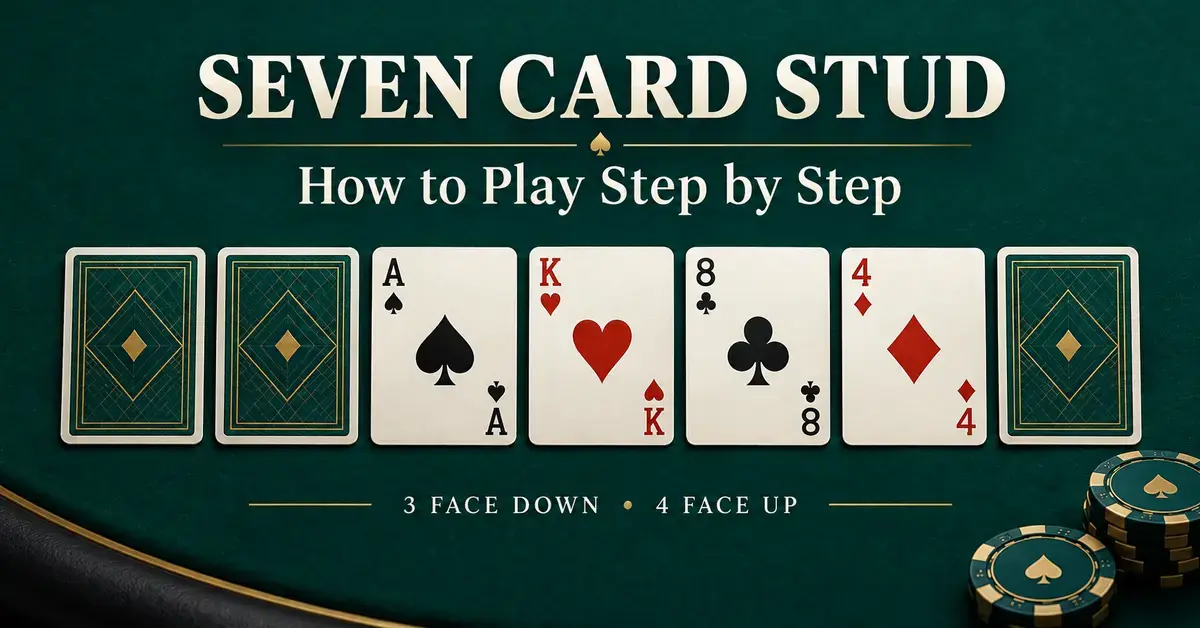
Seven Card Stud is a classic fixed-limit poker game in which each player is dealt seven cards over the course of a hand — some face down and some face up — and makes the best possible five-card poker hand from them. There are no shared community cards as in Texas Hold’em: what you see on an opponent’s board is part of their actual hand, which makes reading the table a central skill. Before the Hold’em boom of the early 2000s, Seven Card Stud was the most widely played poker game in American casinos and home games, and it still appears at the World Series of Poker and in mixed-game rotations today. This guide explains the rules of Seven Card Stud step by step, from the ante to the showdown.
Key Facts
| Game type | Fixed-limit stud poker (no community cards) |
| Players | 2–8 (best with 5–7) |
| Deck | Standard 52 cards, no jokers |
| Cards per player | Up to 7 — 3 face down, 4 face up |
| Forced bets | Ante from everyone + bring-in from the lowest up card |
| Betting rounds | 5 (third through seventh street) |
| Best hand | Best five-card poker hand from your seven cards |
| Notable past | The most popular US poker game before the 2000s Texas Hold’em boom |
What is Seven Card Stud?
Seven Card Stud is a “stud” poker variant, meaning each player receives their own cards — a mix of hidden (face-down) and exposed (face-up) cards — rather than sharing community cards in the middle of the table. Over five betting rounds, every active player is dealt up to seven cards: three face down and four face up. At the end of the hand, each player chooses the best five cards out of their seven to form a hand, using the standard poker hand rankings that run from high card up to the royal flush.
The game is almost always played as fixed-limit poker, which means bets and raises come in set amounts rather than the open-ended “bet anything” structure of no-limit Hold’em. That fixed structure, combined with the information revealed by face-up cards, gives Seven Card Stud a slower, more memory-based rhythm than modern community-card games. It is one of many types of poker, but it remains the benchmark for the whole stud family.
What do you need to play Seven Card Stud?
You need a standard 52-card deck with no jokers, poker chips, and between two and eight players. The game plays best with five to seven players because of how many cards it uses.
- Deck: one standard 52-card deck.
- Players: 2 to 8, with 5–7 being ideal.
- No community cards: unlike Hold’em or Omaha, there is no flop, turn or river shared by everyone.
- Chips for a fixed-limit structure: you set a “small bet” and a “big bet,” where the big bet is double the small bet (for example $5/$10).
Because eight players multiplied by seven cards would need 56 cards — more than a 52-card deck holds — there is a special rule for a full table, explained in the seventh-street section below.
The ante and the bring-in
Every hand of Seven Card Stud starts with forced bets so there is always something to play for. These are the ante and the bring-in, and they work differently from the blinds used in Texas Hold’em.
What is the ante?
The ante is a small mandatory chip that every player puts into the pot before any cards are dealt. It is typically around 10–20% of the small bet. In a $5/$10 game, for example, the ante might be $0.50 or $1 per player. The ante seeds the pot and gives everyone a reason to compete for it.
What is the bring-in?
The bring-in is a forced bet made on the first betting round by the player showing the lowest face-up card. Its size sits between the ante and the small bet — most often half the small bet. If two players are tied for the lowest card, the tie is broken by suit in reverse-alphabetical strength: clubs are lowest, then diamonds, then hearts, then spades. So the player showing the lowest card by both rank and suit must post the bring-in. That player may instead choose to “complete” the bet to the full small bet amount if they want to come in with more aggression. The poker glossary covers the bring-in and other stud-specific terms in more detail.
How the betting works in Seven Card Stud
Seven Card Stud uses a fixed-limit structure built around two bet sizes: the small bet and the big bet, which is exactly twice the small bet.
- Small bets are used on third street and fourth street.
- Big bets are used on fifth, sixth and seventh street.
- Raises are capped — most rooms allow a bet and three or four raises per round.
There is one important exception. On fourth street, if any player is showing an open pair in their face-up cards, every player gets the option to bet either the small bet or the big bet for that round. This “open pair on fourth street” rule is unique to stud and worth remembering.
Seven Card Stud Betting Streets
| Street | Cards dealt | Acts first | Bet size |
|---|---|---|---|
| Third street | 2 face down + 1 face up | Lowest up card (bring-in) | Small bet |
| Fourth street | 1 face up | Highest hand showing | Small bet (big bet allowed if a pair shows) |
| Fifth street | 1 face up | Highest hand showing | Big bet |
| Sixth street | 1 face up | Highest hand showing | Big bet |
| Seventh street (river) | 1 face down | Highest hand showing | Big bet |
How to play Seven Card Stud step by step
A hand of Seven Card Stud is dealt over five “streets,” each followed by a round of betting. Here is what happens on each one.
Third street (the opening deal)
After the antes are posted, each player is dealt three cards: two face down (the “hole” cards) and one face up (the “door” card). The player with the lowest door card posts the bring-in, and betting then proceeds clockwise. Players can call the bring-in, complete it to a full small bet, raise, or fold. All bets and raises on third street use the small bet size.
Fourth street
Each remaining player receives a fourth card face up. From fourth street onward the action order changes: the player showing the strongest poker hand with their exposed cards acts first, and betting continues clockwise. Bets are the small bet — unless a player shows an open pair, in which case anyone may choose the big bet for that round.
Fifth street
A fifth card is dealt face up to each active player. The betting now jumps to the big bet size and stays there for the rest of the hand. Again, the highest hand showing acts first. Fifth street is often considered the key decision point: the pot is growing, bets have doubled, and continuing usually commits you to the hand.
Sixth street
A sixth card is dealt face up, giving each remaining player four exposed cards and two hidden ones. Another round of big-bet betting follows, led by the best hand showing.
Seventh street (the river)
The seventh and final card is dealt face down, so each player ends with three hidden cards and four exposed. A final round of big-bet betting takes place. If eight players are still in the hand and the deck does not have enough cards left, a single card is dealt face up in the middle of the table as a shared community card that counts as everyone’s seventh card.
The showdown
If two or more players remain after the final bet, there is a showdown. Each player makes the best five-card hand from their seven cards, and the strongest hand wins the pot. If the last round had a bet, the player who made the last aggressive action shows first; otherwise the player to the left of the dealer shows first. Tied hands split the pot.
How do you make your best hand from seven cards?
You use any five of your seven cards to form a single five-card poker hand, and the other two cards are simply discarded for scoring purposes. Standard rankings apply, so a flush beats a straight, a full house beats a flush, and so on. Because you are choosing five from seven, strong made hands such as flushes and full houses show up more often than in a two-hole-card game like Hold’em. Knowing the exact order cold — and brushing up on poker strategy fundamentals — matters even more when you must also track what opponents’ face-up cards could be building toward.
Seven Card Stud vs Texas Hold’em
Seven Card Stud and Texas Hold’em are both members of the poker family, but they play very differently. The table below summarises the main contrasts for players coming from Hold’em.
| Feature | Seven Card Stud | Texas Hold’em |
|---|---|---|
| Cards per player | 7 (3 down, 4 up) | 2 hole cards |
| Community cards | None (rare shared river at 8 players) | 5 shared (flop, turn, river) |
| Forced bets | Ante + bring-in | Small blind + big blind |
| Betting rounds | 5 (third–seventh street) | 4 (preflop, flop, turn, river) |
| Usual structure | Fixed-limit | No-limit (most common) |
| Key skill | Memory and reading exposed cards | Position and aggression |
The biggest practical difference is information: in stud, much of each opponent’s hand is visible, and skilled players remember which cards have been folded (“dead” cards) to judge their own chances. If you want to understand the shared-card format for comparison, see the full guide on how to play poker.
Seven Card Stud variants
Several popular games are built on the Seven Card Stud framework, and you will meet them in mixed-game formats.
- Seven Card Stud Hi-Lo (Eight or Better): the pot is split between the highest hand and the best “low” hand of five unpaired cards eight or lower. A player can win both halves (“scoop”).
- Razz: a lowball version of stud where the lowest hand wins and straights and flushes do not count against you; the best possible hand is 5-4-3-2-A (the “wheel”).
- HORSE: a rotating mixed game of Hold’em, Omaha Hi-Lo, Razz, Stud and Stud Eight-or-Better — two of its five games are stud variants, which is why learning stud opens the door to mixed games.
Common Seven Card Stud mistakes
Beginners tend to lose value in a few predictable ways. Avoiding these alone will improve your results.
- Ignoring dead cards. Cards that opponents folded or exposed are gone from the deck. Chasing a flush when two of your suit are already dead is a losing habit.
- Playing too many third-street hands. Strong starting hands — high pairs, three of a kind (“rolled up”), and three high cards or three to a flush — are the ones worth continuing with. Weak, scattered cards should be folded.
- Forgetting the bet doubles on fifth street. Continuing on fourth street is cheap; fifth street onward is expensive. Decide whether your hand is worth big bets before you commit.
- Not watching opponents’ boards. A visible pair, three to a flush or connected up-cards tell you what they might hold. In stud, the board is your opponent’s hand.
- Overvaluing low pairs. A small pair that is not improving is often beaten by the hands opponents are representing with scary up-cards.
Who is Seven Card Stud for?
Seven Card Stud suits players who enjoy a slower, more thoughtful game that rewards memory and patience over the fast aggression of no-limit Hold’em. It is a natural fit for anyone who learned poker before the Hold’em era, for home-game regulars who want variety, and for players curious about mixed games like HORSE. Because it is almost always fixed-limit, swings are smaller than in no-limit formats, which makes it comparatively friendly for newcomers who want to learn hand reading without risking large bets on a single decision. If you prefer bluff-heavy, big-pot poker, Hold’em or Pot-Limit Omaha may appeal more.
Responsible gambling
This article explains the rules of Seven Card Stud for informational purposes only; it is not betting advice and does not suggest that any strategy guarantees a win. Poker played for money carries financial risk, and no method, demo play or tip can change that. Only ever play with money you can afford to lose, set time and spending limits before you start, and never chase losses. You must be of legal gambling age in your jurisdiction. If gambling is affecting you or someone you know, free confidential help is available — in the United States through the National Council on Problem Gambling (call or text 1-800-GAMBLER), and internationally through Gambling Therapy. Check the official regulator and support services in your own country for local resources.
Sources
Frequently Asked Questions (FAQ)
How many cards do you get in Seven Card Stud?
Each player is dealt up to seven cards over the hand: three face down and four face up. At the showdown you use the best five of those seven cards to make your poker hand, and the other two do not count.
What is the bring-in in Seven Card Stud?
The bring-in is a forced bet on third street made by the player showing the lowest face-up card. It is usually half the small bet. If players tie for the lowest card, the tie is broken by suit, with clubs lowest and spades highest.
Is Seven Card Stud harder than Texas Hold’em?
It is not harder to learn, but it rewards different skills. Stud demands good memory and the ability to read opponents’ face-up cards and track folded (dead) cards, whereas Hold’em leans more on position and aggression with shared community cards.
Can Seven Card Stud be played as no-limit?
It is almost always played as fixed-limit, with a set small bet and big bet (the big bet being double the small bet). Pot-limit versions exist in some rooms, but no-limit stud is rare because the exposed cards make it very swingy.
How many players can play Seven Card Stud?
Between two and eight players, with five to seven being ideal. With a full table of eight, the deck can run short, so a single shared community card is dealt face up to serve as everyone’s seventh card.
