
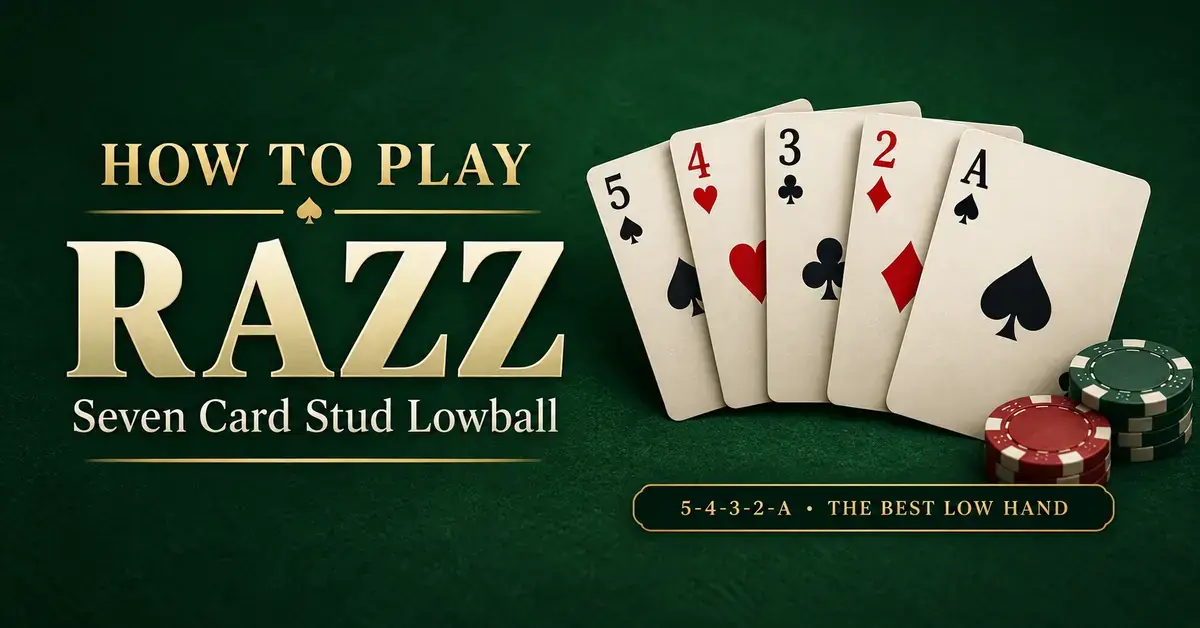
Razz is seven-card stud turned upside down: instead of building the highest hand, you are trying to make the lowest five-card hand out of seven cards. It uses no community cards, no flop and no board you share with the table (with one rare exception), and the goal reshuffles everything a Texas Hold’em player thinks they know — pairs are bad, aces are gold, and straights and flushes simply do not matter. This guide explains the rules of Razz from the ante to the showdown, shows you how to read a low hand, and walks through the strategy that wins at the beginner and intermediate level.
Key Points
- Goal: make the lowest five-card hand from seven cards — the opposite of most poker.
- Best hand: 5-4-3-2-A, the “wheel” or “bicycle.”
- Aces are always low; straights and flushes do not count against you.
- Format: seven-card stud structure — ante, bring-in and five streets (3rd–7th), no community cards.
- Bring-in: the highest door card pays it (reverse of high stud).
- Action order: from fourth street on, the lowest exposed hand acts first.
- Where it’s played: the “R” in H.O.R.S.E. and a WSOP bracelet event since 1971.
What is Razz poker?
Razz is a lowball form of seven-card stud in which the best possible hand is the lowest five cards, not the highest. It is dealt from a standard 52-card deck to between two and eight players, and like all stud games it has no shared community cards — each player builds their own hand from the cards they are dealt individually. Over the course of a hand you receive seven cards in total, and at showdown your best five of those seven count.
The scoring system is called ace-to-five low, the same ranking used in ace-to-five triple draw. Under this system the ace always counts as the lowest card, and straights and flushes are ignored completely when judging a low hand. That single rule is why the game feels inverted: a hand that would be worthless in Hold’em can be the strongest holding in Razz. If you are new to the wider family of games, our overview of the types of poker shows where Razz sits alongside Omaha, Short Deck and the other stud variants.
How Razz differs from regular poker
The quickest way to understand Razz is to flip the usual objective. In most poker you climb the ladder of poker hand rankings toward flushes, full houses and quads. In Razz you run the opposite direction and want unconnected, unpaired low cards. Three key reversals define the game:
- Low wins. The lowest five-card hand takes the pot, so you want small cards (ace through eight) rather than big ones.
- Aces are always low. An ace counts as a 1, making it the most valuable card in the deck.
- Straights and flushes do not count. Holding five cards in sequence or five of a suit does nothing — it is still read purely as five low cards.
Razz hand rankings: why the wheel wins
The best possible hand in Razz is 5-4-3-2-A, known as the wheel or the bicycle. Because straights and flushes are ignored and the ace plays low, there is no lower five-card combination than five, four, three, two, ace. Everything else is measured against it.
How to read a Razz low hand
A low hand is ranked from its highest card downward, so you compare the top card first and only move to the next card to break a tie. The lower your highest card, the better your hand. Players name hands by their top one or two cards: a hand topped by an eight is an “eight-low,” and 8-6-4-2-A is read as an “eight-six low.”
When two players share the same highest card, the next card decides it, and so on down the five cards. For example, 7-6-4-3-A beats 7-6-5-2-A because the third card (a 4) is lower than a 5. Suits never matter for the hand itself — they are only used, in the correct ranking, to decide who posts the forced bet at the start of a hand.
From best to worst
- Wheel (5-high): 5-4-3-2-A — the nuts, unbeatable.
- Six-low: e.g. 6-4-3-2-A, the next tier down.
- Seven-low: e.g. 7-5-4-2-A — still a very strong hand that wins most pots.
- Eight-low: e.g. 8-6-4-2-A — a solid but beatable holding.
- Pairs and worse: if you cannot avoid pairing, the pair counts against you. A hand with a pair loses to any five unpaired cards, and the worst Razz hand of all is three of a kind with high cards — effectively the best high hands are the worst low hands.
Many terms in this guide — bring-in, door card, street — appear across all stud games; if any are unfamiliar, the poker glossary defines them in plain English.
How a hand of Razz is dealt
Razz is dealt over five betting rounds called streets, numbered third through seventh. Before any cards come out, every player posts an ante — a small forced bet that seeds the pot. The dealer then begins the deal.
The ante and the bring-in
The ante is posted by everyone at the table. After the first three cards are dealt, one player must post the bring-in, a second small forced bet that starts the action. Here is the first Razz twist: because the game rewards low cards, the player showing the highest up-card (the “door card”) must post the bring-in — the exact opposite of ordinary seven-card stud, where the lowest card brings it in.
The king is the highest-ranking card, so a king showing forces the bring-in. If two players show the same highest rank, the suit decides who pays, ranked spades (high), hearts, diamonds, then clubs (low). The bring-in player can instead choose to “complete” the bet to the full small-bet size if they prefer to come in raising.
Third through seventh street
Each player who stays in the hand receives seven cards across the streets:
- Third street: two cards face down and one face up (the door card). The highest door card posts the bring-in, then action moves clockwise.
- Fourth street: one card face up. A betting round follows.
- Fifth street: one card face up, then betting.
- Sixth street: one card face up, then betting.
- Seventh street (the river): one card face down, then the final betting round and showdown.
By showdown each remaining player holds three hidden cards and four exposed ones, and chooses their best five low cards from the seven.
What happens if the deck runs low
With up to eight players each taking seven cards, the 52-card deck can occasionally run short. In the rare case that all eight players stay in to seventh street, there are not enough cards to give everyone a final down card. Instead, the dealer turns a single card face up in the middle of the table as a community card that every remaining player uses as their seventh card. This is the only time Razz uses a shared card.
Razz betting rules and the order of action
Razz is almost always played as a fixed-limit game, meaning bets and raises come in set amounts rather than any size you choose. In a game described as, say, $10/$20, the small bet is $10 and the big bet is $20.
- Third and fourth street: all bets and raises are the small bet ($10).
- Fifth, sixth and seventh street: all bets and raises are the big bet ($20).
- Each round is typically capped at a bet plus three raises (four bets total).
A detail that separates Razz from high stud: in seven-card stud a player can choose the big bet on fourth street if they have an open pair. In Razz pairs are meaningless, so that option does not exist — fourth street is always the small bet.
The order of action also flips after the first street. On third street the bring-in (the highest, worst card) acts first. From fourth street onward, the player showing the lowest — and therefore best — exposed hand acts first. Because the best board acts first throughout the hand, position in Razz shifts with every card, and reading the exposed boards is central to good play. For the fundamentals that carry across every game, see our guide to poker strategy.
How Razz compares with seven-card stud
Razz and seven-card stud share the same skeleton — antes, a bring-in and five streets — but reverse almost every goal. The table below lays out the practical differences a player feels at the table.
Razz vs Seven-Card Stud
| Feature | Razz | Seven-Card Stud (high) |
|---|---|---|
| Objective | Lowest five-card hand | Highest five-card hand |
| Ace value | Always low | High (or low in a straight) |
| Straights & flushes | Ignored | Count as strong hands |
| Pairs | Bad — count against you | Good — build toward big hands |
| Who posts the bring-in | Highest door card | Lowest door card |
| Acts first (4th st. on) | Lowest exposed hand | Highest exposed hand |
| Open pair on 4th street | No bet-size option (pairs irrelevant) | Allows the big bet |
| Best possible hand | 5-4-3-2-A (wheel) | Royal flush |
Razz strategy for beginners
Winning Razz starts with patience and clean starting hands, because small edges on third street compound over five betting rounds. The core idea is simple: enter pots with three low cards, keep your exposed cards lower than your opponents’, and apply pressure on the expensive streets when you stay unpaired.
Which starting hands to play
Your three third-street cards set the tone. In order of strength:
- Three to a wheel: three cards of five or lower, such as A-2-3 or 4-3-2, are premium. These are raising hands.
- Three low cards, seven or better: any three unpaired cards of seven or lower (for example 7-5-A) are strong and worth playing.
- Three-card eight: hands topped by an eight are playable but marginal — proceed with caution, especially against a lower-looking board.
- Fold the rest: any hand containing a card of nine or higher, or a pair, is usually a fold. A paired card already puts you behind the field.
A hand’s strength also depends on whether your low cards are hidden. A buried low (two low cards down and a higher door card) disguises your hand; a low door card advertises strength but invites fewer callers.
Watch the door cards
Every up-card on the table is information. Count the low cards your opponents are showing or have folded — these are “dead” cards you can no longer catch. If several deuces and threes are already visible, your own draw to those ranks is weaker. Conversely, if an opponent’s door card is a king or queen, they are likely bringing in with a weak hand and are a prime target to pressure. Stealing antes and bring-ins when you show a low card against high door cards is a steady source of profit.
Playing the later streets
Watch how boards develop. When you “catch good” (pick up another low card) while an opponent “catches bad” (pairs or catches a high card, a so-called brick), you should bet and raise — your hand improved while theirs stalled. When the reverse happens and you brick while an opponent’s board stays low, be ready to fold rather than chase. By fifth street you are committing big bets, so the cost of calling with the worst of it climbs quickly. Understanding pot odds helps you decide whether a draw is worth continuing; our primer on poker odds and probability covers the math.
Common Razz mistakes to avoid
Most losing Razz play comes from a handful of repeated errors:
- Playing too many hands. Entering with a three-card nine or a pair bleeds chips. Discipline on third street is the single biggest edge.
- Chasing after bricking. Calling down when you keep catching high cards and your opponent’s board stays low is the fastest way to lose big bets.
- Ignoring dead cards. Failing to track which low cards are already gone leads you to draw to outs that no longer exist.
- Overvaluing a made eight. An eight-low wins some pots but loses to any seven or better; treat it as a modest hand, not a monster.
- Forgetting that straights and flushes don’t help. Beginners sometimes shy away from a connected or suited low — those patterns are irrelevant and change nothing.
Where to play Razz
Razz is a classic that rarely runs as its own cash game outside dedicated mixed-game rooms, but it appears reliably in two places. First, it is the “R” in H.O.R.S.E., the mixed-game rotation that cycles through Hold’em, Omaha hi-low, Razz, Stud and Stud hi-low. Second, it is a long-standing event at the World Series of Poker: Razz has featured at the WSOP since 1971 and remains a bracelet event today. If you enjoy the live-event side of the game, our guide to poker tournaments explains how the WSOP and other series are structured.
Who Razz suits
Razz rewards patience, card reading and emotional control more than flashy aggression, so it suits methodical players who enjoy grinding small edges. Because so many hands come down to who catches better on the later streets, it can be a swingy, frustrating game for players who hate folding. It is also an excellent way to broaden your skills: learning to read exposed boards and track dead cards sharpens habits that transfer to every stud and mixed game. If you are still mastering the basics of betting and showdowns, start with our step-by-step guide on how to play poker before taking a seat.
Responsible gambling
This article explains the rules and strategy of Razz for informational purposes only. It is not betting advice, and no strategy, demo play or tip can guarantee a win — poker outcomes always involve chance, and you can lose money. Play only with money you can afford to lose, set limits before you start, and treat the game as entertainment rather than a way to make income. If gambling stops being fun or feels out of control, free and confidential help is available from BeGambleAware, GamCare and the National Council on Problem Gambling. Players must be of legal gambling age in their jurisdiction.
Sources
Frequently Asked Questions (FAQ)
What is the best hand in Razz?
The best hand is 5-4-3-2-A, called the wheel or the bicycle. Because the ace plays low and straights and flushes are ignored, no lower five-card combination exists, so the wheel is unbeatable.
Do straights and flushes count in Razz?
No. Straights and flushes have no effect on a Razz hand. A hand like 5-4-3-2-A is still read as a five-low, not as a straight, and five cards of one suit are judged purely on their ranks.
Who posts the bring-in in Razz?
The player showing the highest door card must post the bring-in, which is the reverse of ordinary seven-card stud. If two players tie for the highest card, the suit order — spades, hearts, diamonds, clubs — decides who pays.
How many players can play Razz?
Razz is played with two to eight players using a standard 52-card deck. If all eight players reach seventh street, the dealer places one shared community card face up because the deck would otherwise run out.
Is Razz good for beginners?
Razz is beginner-friendly in its rules but demands patience and discipline to play well. The hardest adjustments are valuing low cards, folding anything with a high card or a pair, and resisting the urge to chase after catching badly.
