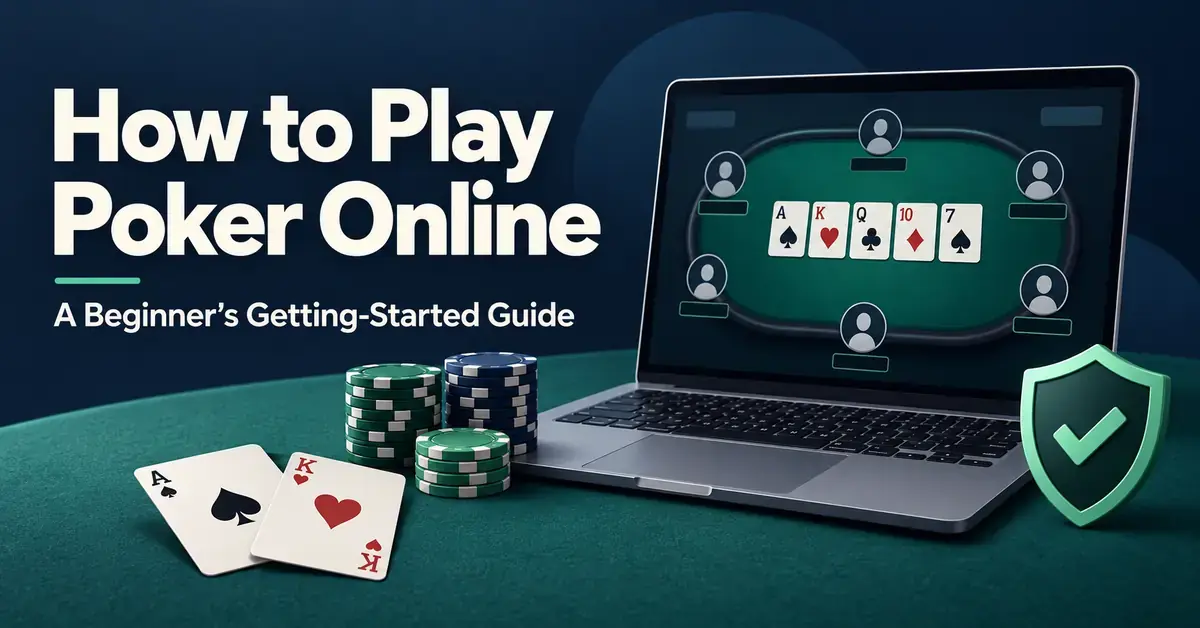
Playing poker online means playing the same card game you would find in a casino or a kitchen-table home game, but through software on a computer, phone or tablet, against real people connected from around the world. The rules are identical to live poker — what changes is how you sit down, how money moves in and out, and how quickly the action runs. This guide walks a complete beginner through the practical steps: choosing a licensed site, creating and verifying an account, practising for free, making a first deposit and joining a table, plus how to stay safe and in control while you learn.
Key Points
- What it is: the same poker you play live, run through software on a computer, phone or tablet against real opponents.
- Legal check first: regulated state-by-state in the US (21+), licensed by the UK Gambling Commission in Britain (18+); always confirm the law where you are.
- Getting started: pick a licensed site, create and verify your account, practise on play money, then make a small first deposit.
- Start small: one table, micro-stakes, Texas Hold’em cash game — and only money you can afford to lose.
- Stay safe: licensed sites use certified random shuffling, encryption and anti-collusion systems; use a strong password and the built-in limit tools.
What does playing poker online actually mean?
Online poker is ordinary poker played through a software client instead of around a physical table. The shuffle and deal are handled automatically by a random number generator (RNG) — a program that produces unpredictable card orders — so there is no human dealer. On screen you see your own two (or more) cards, a shared pot, buttons to fold, check, call, bet or raise, and a countdown timer that forces you to act within a set number of seconds.
Two things make the online version distinct from a casino. First, you can play several tables at once, something impossible in a live room. Second, every site offers two money modes: play money, using free virtual chips, and real money, where deposits and winnings are actual currency. Texas Hold’em is by far the most common game online, but most rooms also spread Omaha, Seven-Card Stud and faster formats. If you want the full menu of variants, see our guide to the different types of poker.
Do you need to know the rules before playing online?
Yes — you should understand at least the basics before you sit down for real money. The software enforces the rules for you (it will not let you make an illegal bet), but it will not stop you making a bad one. At a minimum, learn the order of winning hands and how the betting rounds flow.
Two short reads cover everything you need: our step-by-step explainer on how to play poker, which walks through blinds, betting rounds and showdown, and the complete poker hand rankings from royal flush down to high card. Spend 20 minutes with those first and the online tables will make immediate sense.
Is online poker legal where you live?
Whether you can legally play real-money poker online depends entirely on your country — and, in the United States, on your individual state. Always confirm the law in your own jurisdiction before depositing.
United States
Real-money online poker is regulated state by state, not nationally. As of 2026 it is legal and licensed in eight states: Nevada, Delaware, New Jersey, Pennsylvania, Michigan, West Virginia, Connecticut and Rhode Island. To play, you must be 21 or older and physically located inside a regulated state when you log in — sites confirm this with geolocation software. Several states share their player pools through the Multi-State Internet Gaming Agreement (MSIGA), which is why a site such as WSOP Online can combine players from Pennsylvania, Michigan, New Jersey and Nevada at the same tables. Players in states without regulated poker sometimes use offshore sites, but those operate outside US law and offer no legal protection for your money.
United Kingdom and Europe
In the United Kingdom, online poker is legal and regulated by the UK Gambling Commission, with a minimum age of 18. Across continental Europe the picture is mixed: countries including France, Spain, Italy and Portugal license their own ring-fenced markets, while others allow operators licensed elsewhere in the EU. Check which sites hold a licence valid for your country.
Rest of the world
Many countries in Canada, Latin America, Asia and Oceania permit online poker under local or offshore licences, but rules vary widely and change often. The safe approach everywhere is the same: only play on a site that is licensed to accept players from your location, and only if you are of legal gambling age there.
How do you choose a safe online poker site?
Choose a site by licensing and security first, and features second. A poker room can have the slickest software in the world, but if it is unlicensed your deposit has no protection. Look for these things, roughly in order of importance:
- A valid licence from a recognised regulator (for example a US state gaming authority or the UK Gambling Commission), usually shown in the site footer.
- Encryption and account security — a secure (HTTPS) connection and the option for two-factor authentication.
- Player traffic — more players means more games running at the stakes you want, more often.
- Game and format choice — cash games, tournaments and faster formats at micro-stakes so you can start cheaply.
- Clear banking — transparent deposit and withdrawal methods and reasonable processing times.
- Responsible-gambling tools — deposit limits, session timers and self-exclusion built into the cashier.
- Reputation and support — a track record of paying players and responsive customer service.
The rake — the small percentage the site takes from each pot or tournament fee — also matters over time, but it should not be your first filter as a beginner.
How to start playing poker online, step by step
Getting from “never played online” to “seated at a table” takes about 15 minutes. Follow these steps in order.
Step 1: Pick a licensed site and install the software
Choose a room that is licensed for your location, then download its client from the official website or your device’s app store. Most sites offer a downloadable desktop client, a browser version and a mobile app. Installing from the official source is important — it avoids tampered copies.
Step 2: Create and verify your account
Register using your real, accurate personal details. This is not optional: licensed sites are legally required to verify your identity and age (a process often called KYC, “know your customer”), usually by asking for a photo ID and sometimes proof of address. You will also pick a screen name that other players see — that one does not have to be your real name.
Step 3: Practise on play money first
Before risking a cent, open a play-money table and get comfortable with the interface: find the fold, call and raise buttons, the bet-sizing slider, the cashier and the table options. Play money is the safe place to learn where everything is. Just remember its limitation (explained below): play-money opponents behave nothing like real ones.
Step 4: Make your first deposit
When you are ready for real money, open the cashier (sometimes labelled “deposit” or “bank”). Common methods include debit cards, bank transfers and e-wallets such as PayPal, Skrill or Neteller, depending on your country. Deposit only what you have decided you can afford to lose, and set a deposit limit in the same screen if the option is offered.
Step 5: Join your first table
Open the lobby, filter by game (start with Texas Hold’em) and by the lowest stakes available — often called micro-stakes, sometimes just a few cents. Pick a table, choose how many chips to bring (your “buy-in”), and take a seat. Act when it is your turn before the timer runs out. Playing one table at a time while you learn is strongly recommended.
Quick Facts
| Minimum age | 18 in the UK/much of Europe; 21 in regulated US states |
|---|---|
| What you need | A device, an internet connection, a verified account and funds |
| Most common game | No-Limit Texas Hold’em |
| Money modes | Play money (free chips) and real money |
| Typical deposit methods | Debit card, bank transfer, e-wallets (PayPal, Skrill, Neteller) |
| Regulators | US state gaming authorities; UK Gambling Commission; national EU regulators |
| Beginner stakes | Micro-stakes cash games, from a few cents |
Online poker vs live poker: what is different?
The biggest difference is speed and volume. Online tables deal two to three times as many hands per hour as a live game, and you can play more than one table at once, so you see far more hands in an evening. Other differences:
- No physical tells. You cannot read faces or body language online; information comes from bet sizes, timing and betting patterns instead.
- Lower stakes available. Online micro-stakes start at a few cents, far below the minimum in most casinos.
- Software does the work. The dealer, pot calculations and payouts are all automatic, so there are no dealer errors or disputes.
- Multi-tabling. Experienced players run many tables simultaneously; beginners should not.
- Time pressure. A clock forces you to decide quickly, which can feel rushed at first.
Cash games, tournaments or sit & gos: where should a beginner start?
Most beginners find cash games the easiest entry point. Here is how the three main formats compare:
- Cash games use real chips that equal real money; you can join or leave at any time and rebuy if you lose your stack. The flexibility makes them ideal for short sessions and for learning.
- Multi-table tournaments (MTTs) have a fixed buy-in, a set start time and a prize pool paid to the top finishers. They can last hours, so commit the time before you start. See our overview of how poker tournaments work.
- Sit & gos (SNGs) are mini-tournaments that start as soon as enough players register — often just a single table. They are a good halfway house: tournament-style play in a predictable, shorter package.
Play money vs real money
Play money is for learning the software, not for learning how to win. Because the chips have no value, opponents at play-money tables call with almost anything and go all-in recklessly, so the game plays nothing like real poker. Use play money to master the buttons and the lobby, then switch to the lowest real-money stakes to learn how people actually play when something is on the line. No amount of play-money success changes your odds at a real-money table — the two are simply different environments.
Deposits, withdrawals and protecting your bankroll
Your bankroll is the money you have set aside specifically for poker, separate from money you need for living. Managing it is the single most important habit for lasting longer at the tables. A few ground rules:
- Only deposit money you can comfortably afford to lose.
- Keep many buy-ins for your stake level so a normal run of bad luck cannot wipe you out — a common guideline is at least 20 buy-ins for cash games.
- Move up in stakes only when your bankroll clearly supports it, and move back down without ego if it shrinks.
- Withdraw winnings periodically rather than letting your balance tempt you into higher stakes.
For the wider picture — starting hands, position and aggression — read our guide to poker strategy.
Comparison of major online poker sites
The table below lists well-known, licensed poker rooms and where they operate. Availability depends on your location, and not every site accepts players everywhere — always confirm the licence valid for your country or state before signing up.
| Site | Operator / parent | Where it is typically available | Known for |
|---|---|---|---|
| GGPoker | NSUS Group | International markets (not US real-money) | Largest global cash-game traffic |
| PokerStars | Flutter Entertainment | International plus regulated US states (NJ, PA, MI) | Huge tournament schedule |
| WSOP Online | NSUS Group | Regulated US states (NV, NJ, PA, MI) | Multi-state shared player pool |
| 888poker | Evoke plc (888 Holdings) | International plus some regulated US states | Beginner-friendly tables |
| partypoker | Entain | International markets | Long-running global brand |
| WPT Global | World Poker Tour | International markets (not US real-money) | Fast-growing recreational traffic |
Common beginner mistakes online
Most early losses come from a handful of avoidable errors rather than bad luck. Watch for these:
- Starting at stakes that are too high. Begin at micro-stakes where mistakes cost pennies, not a week’s budget.
- Opening too many tables at once. Multi-tabling splits your attention before you have the fundamentals; stick to one.
- Playing too many hands. Folding weak starting hands is not boring — it is most of the game.
- Ignoring position. Acting after your opponents gives you information; acting first gives it away.
- Chasing losses. Trying to win back a bad session by raising stakes is the fastest way to lose a bankroll.
- Skipping the maths. Learning poker odds — outs, pot odds and the rule of 2 and 4 — turns guesses into informed decisions.
Is online poker safe and fair?
On a properly licensed site, online poker is both secure and fair, because regulators require it. The deal is produced by a certified random number generator that is independently tested for true randomness, so no one — including the site — can predict or control the cards. Licensed operators also encrypt your connection and run systems to detect collusion (players secretly teaming up) and prohibited bots (automated programs playing as if human), removing and refunding affected players when they are caught.
Your own habits matter too. Use a strong, unique password, switch on two-factor authentication if the site offers it, never share your account, and only ever log in through the official app or website. These steps protect your balance far more than any worry about the deal being “rigged” on a regulated room.
Can you play poker online on a phone?
Yes — almost every major poker room has a mobile app for iOS and Android, and many also run directly in a mobile browser. Apps carry the same games, stakes and cashier as the desktop client, so you can deposit, play cash games or tournaments, and withdraw entirely from your phone. The trade-off is screen size: multi-tabling is harder, and small bet-sizing controls take some getting used to. If you want to compare options, see our roundup of the top poker apps.
Who is online poker for?
Online poker suits anyone who enjoys a game of skill and chance, wants to play on their own schedule, and can treat the money as entertainment rather than income. Micro-stakes make it accessible on almost any budget, and the ability to start on play money makes it approachable for total beginners. It is not a good fit for anyone hoping to make quick or guaranteed money, or for anyone who struggles to stop once they start — poker involves real financial risk and should only ever be played with money you can afford to lose.
Responsible gambling and disclaimer
This article is for information only and is not gambling, financial or legal advice. Poker played for real money involves a genuine risk of losing that money, and no strategy, guide or practice can guarantee a win. You must be of legal gambling age in your jurisdiction — generally 18 in the UK and much of Europe, and 21 in regulated US states — and play only on sites licensed to accept you.
Set a budget before you play, use the deposit and session limits built into licensed sites, and never chase losses. If gambling stops being fun or starts to feel like a problem, free and confidential help is available. In the United States, contact the National Council on Problem Gambling via its 24/7 helpline at 1-800-GAMBLER or ncpgambling.org. In the United Kingdom, contact GamCare or BeGambleAware. Licensed sites also offer self-exclusion tools that block your account for a chosen period.
Sources
- UK Gambling Commission — information for players
- New Jersey Division of Gaming Enforcement
- National Council on Problem Gambling
- PokerListings — MSIGA multi-state poker compact explained
- PokerFuse — Pennsylvania joining multi-state online poker
- BusinessWire — Caesars closes sale of the WSOP brand to NSUS Group
- BeGambleAware — free gambling support
Frequently Asked Questions (FAQ)
Is it hard to learn to play poker online?
No. The software enforces the rules, deals automatically and shows you which actions are legal, so the mechanics are easy to pick up. Learning to play well takes longer, but you can start by practising on free play-money tables and then moving to the lowest real-money stakes.
How much money do I need to start playing poker online?
Very little. Micro-stakes cash games can start at just a few cents a hand, and many sites let you deposit small amounts. Only ever deposit money you can afford to lose, and keep enough buy-ins in reserve so a normal losing run does not clear you out.
Can I play online poker for free?
Yes. Every major poker site offers play-money tables where you use free virtual chips at no risk. They are perfect for learning the interface, though opponents there play very differently from real-money tables.
Is online poker rigged?
On a licensed site, no. The cards are dealt by a certified random number generator that is independently tested for fairness, and operators run systems to detect collusion and bots. The real risk comes from playing on unlicensed, unregulated sites, which you should avoid.
What is the best poker game for a beginner to start with online?
No-Limit Texas Hold’em at micro-stakes, played as a cash game on a single table. It is the most widely available game, the easiest to find beginner tables for, and the format most guides and tools are built around.
